 University of North Texas

- About Us
- Undergraduate Studies
- Graduate Studies
- Back
- Graduate Studies
-
- Apply to the Graduate Program in History
- Master's Program
- Online Teachers Program
- PhD Program
- Scholarships, Funding & Financial Aid
- Faculty Concentrations and Categories
- Facilities
- Graduate Course Catalog
- Student Profiles
- Placement
- Graduate Student Handbook
- Graduate Student Forms
- Contact Graduate Program Personnel
- People
- Department
- Events
- Forms
- Donations
- Alumni
Tejanos & Wars Podcast

Welcome to the History & Memory: Tejanos & American Wars Podcast!
A podcast tracing the history of Tejanos in American military conflicts & how memory
is tied to historical experience. Presented by Alex Mendoza and Steve Sisson.
Access PDF transcripts of all episodes below.
- Episode 1 - History & Memory: An Introduction
- Episode 2 - "Some Envied My Position, As Held By A Mexican," Precolonial to Texas Revolution
- Episode 3 - "Now, Is He A Mexican Or A Texan," Mexican-American & Civil Wars
- Episode 4 - "I Am An American First, Last & All The Time," Reconstruction to the Spanish-American War
- Episode 5 - "For Honor, For Patriotism... For Our Own Best Interests," World War I
- Episode 6 - "I think Nobody Is More American Than I," World War II
- Episode 7 - "Yo Quería Ser Americano," WWII to the Korean War
- Episode 8 - "We Promised To Get Each Other Through," Civil Rights & the Vietnam War
- Episode 9 - Monuments as Memory: A Conclusion
In the first introductory episode of the History and Memory Podcast, Alex Mendoza and Steve Sisson explore the genesis for the book and the resulting podcast. The idea of historical memory traces the experiences of the two friends as students at the University of Texas at Austin in the 1990s, when racial strife on the school campus spread to the idea of statues to Confederate heroes near the Main Building. The example at UT relates to the broader notion of how Mexican American communities want to influence public history by erecting statues and monuments to Tejano soldiers along the Texas-Mexico border. Additional topics include the legacy of the Texas Rangers, the complexity of Tejano identity, and reflections on being Texan and American.
Episode 2 analyzes how Texans of Mexican descent fought in numerous conflicts since before the Republic of Texas gained its independence in 1836. The episode explores the story of Juan Seguin, a San Antonio Tejano who fought on behalf of the Texas Republic army and became the mayor of San Antonio during the 1840s. He was ultimately run out of Texas as suspicions about his loyalty to Mexico made his political life untenable. These doubts about Tejano loyalty and the desire to remove Mexican Texans from the power structure of Texas Republic politics caused friction, confusion, and conflict.
Episode 3 traces the onset of the Civil War and how the war placed the Mexican American population in a precarious position, forcing them to choose between the Union and Confederate loyalties, once more. The juxtaposition of Juan N. Cortina and Santos Benavides, both born in Texas under the Mexican flag in the 1820s, serves as an important platform to discuss the idea of loyalty. Benavides was rewarded for his support of the Confederacy and served in the Texas House of Representatives and had a school named after him and appeared on the cover of the phonebook for his hometown of Laredo. Cortina, on the other hand, became a folk hero for the Mexican American community in the Brownsville area, earning the respect of his contemporaries and lived on in corridos (folk songs) that chronicled his exploits as a Mexican outlaw.
Episode 4 examines how Tejanos slowly moved away from participation in their state’s martial conflicts. This ultimately led to the Anglo Texans further questioning the loyalty of the Texas Mexican population by the onset of the Spanish-American War, in 1898. Some Tejanos volunteered to fight but the numbers and support for the war were largely absent. Doubts about Tejano loyalty stemmed from the authorities in Mexico City who suggested that Tejanos were easily susceptible to manipulation. Accordingly, Texas and US officials worried about Tejano loyalty during the hostilities with Spain. Political and economic leaders focused on perceived disloyalty from the Tejano communities in the state. Yet Tejanos who joined the ranks of the Army did so under their own prerogative.
Episode 5 studies the watershed events of the World War I era. The Great War thrust the Mexican Texan population into the maelstrom of an American war with implications for the Tejano population. The podcast episode traces the challenges of enlistment, including language and education, as well as the efforts of the federal authorities to assimilate the new enlistees. Additional attention is paid to the violent period known as “La Matanza” (the killings) during the 1910s and the impact of segregation policies in Texas with what is referred to as Juan Crow laws. Yet, heroes like Marcelino Serna and David B. Cantu demonstrate their martial spirit in the “War to end all Wars.”
Exploring how the Tejano community recognized the need to fight for civil rights and for their country during World War II is one of the cornerstones of Episode 6. After the Japanese attack on Pearl Harbor on December 7, 1941, the Tejano community responded with the patriotic fervor of their Anglo-American neighbors. This was evident in the fact that as many as 750,000 Texans served in the armed forces during the war, a proportionally larger percentage than any other state. Of those, it is estimated that more than 100,000 Tejanos served in the United States armed forces. The entire Tejano community supported the war effort to defeat the Axis powers. The exploits of Company E (El Paso), the only unit made up of Mexican Americans, Macario Garcia (the first immigrant to earn a Congressional Medal of Honor), and the Tejano community on the homefront are discussed.
Episode 7 examines the Cold War era conflict of Korea. Reminders of how Mexican-Texans are still regarded as second class citizens is evident with the Felix Longoria affair in Three Rivers and with the beating of Private Benigno Aguirre in San Angelo. As the nation pivoted to fight the spread of communism, Tejanos continued to make choices. In some respects, the patriotic fervor that marked enlistment in World War II was absent from the Korean War. Nevertheless, civil rights organizations like LULAC and the newfound American GI Forum, promote the concept of American values and ideals through peaceful navigation of the litigation process. Mexican immigrants like Raul Chavarria from Nuevo Laredo continue to enlist for the U.S. Army with hopes of earning U.S. citizenship.
Episode 8 traces the changing landscape of civil rights and its impact on Tejano military service during the 1960s and the Vietnam War era. The rise of the Chicano movement takes on the idea of non-assimilation and embracing the indigenous roots of Mexican Americans. Military service is still seen as a way out of poverty. But additional factors influence Tejanos: Hollywood and family history. Unlike prior wars, many veterans mention that they fought for their fellow soldiers and somehow forgot about home and country. While heroes like Raul “Roy” Benavidez and others continue to demonstrate the prowess of Tejanos in combat, the Tejano community is emboldened to criticize the war more than prior conflicts. Tejanos memorialize this war with murals and community projects, akin to the impact of Chicano art and resistance.
In the final episode of the podcast, we explore the idea of memory and how the Tejano community has employed a proactive approach to commemorate military service along the Texas-Mexico border. Monuments to Mexican American veterans take a pronounced place in Laredo, El Paso, and McAllen, cities whose demographics include more than 80 percent Hispanic residents. Additional efforts to recognize Tejanos include the naming of streets, buildings, and schools. The story of Vietnam War hero, Alfredo “Freddy” Gonzalez resonates as he had the first U.S. warship, the U.S.S. Gonzalez, a destroyer named in his honor. Ultimately, Tejanos continue to agitate for recognition as many view military service lays a claim to the status of citizenship.
About the Book

This podcast series is a companion piece to Dr. Alex Mendoza's latest book Reason's We Fight: Tejanos and American Wars, 1836-1972.
You can find a copy at any large book retailer including Amazon, Kindle, Barnes & Nobles, Google Play Books, Kobo, Books-A-Million, as well as directly from the publisher University of Oklahoma Press.
Refusing to Forget
To learn more about state sanctioned anti-Mexican violence on the Texas-Mexico border (1910-20), as well as current historical projects and initiatives to bring public awareness to this time period, visit the award-winning educational non-profit organization Refusing to Forget.
Images
Below you will find three images that are referenced by Dr. Alex Mendoza within the podcast series.
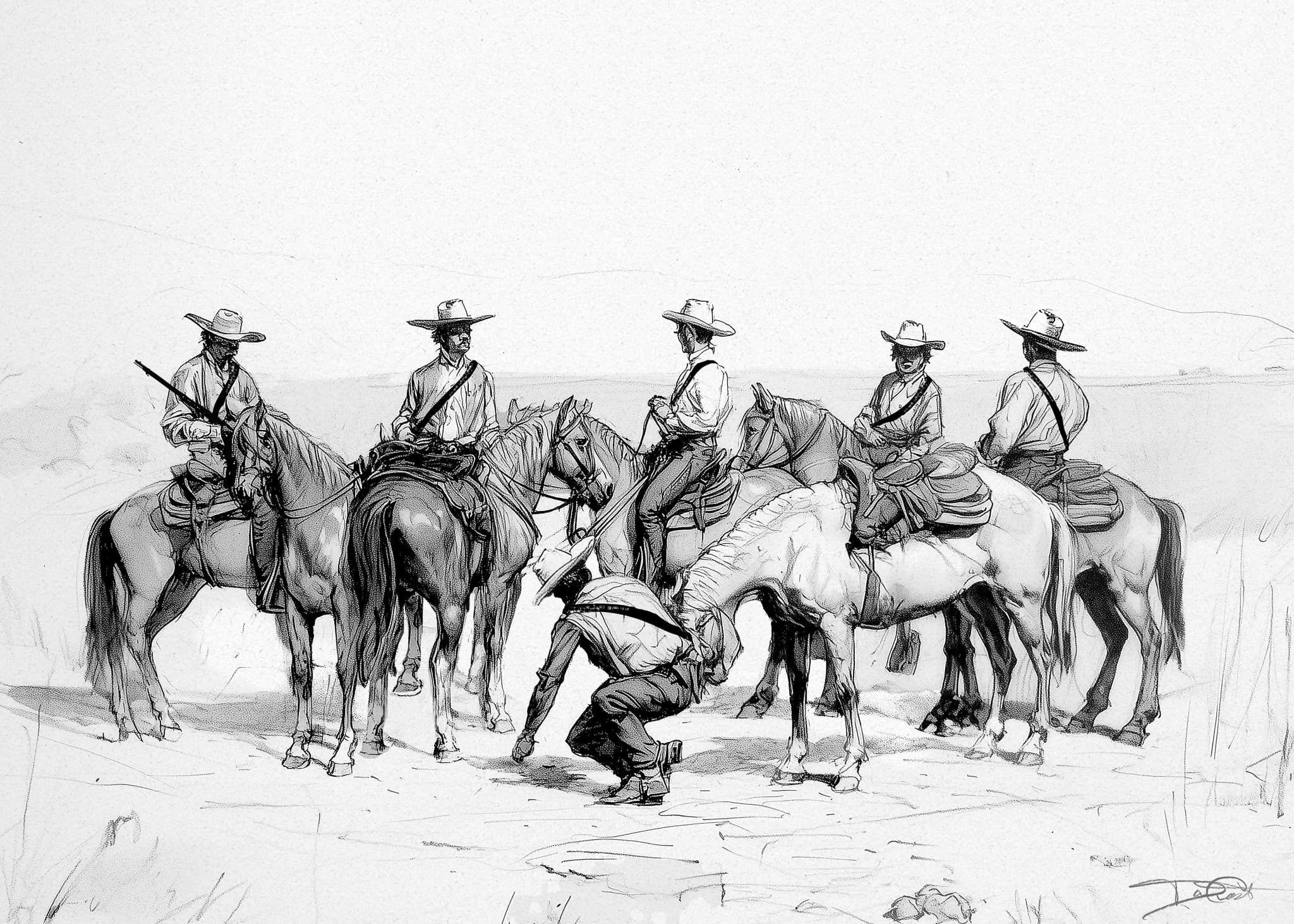
La Compañía Volante by Daniel Castro, San Antonio. Compañías Volantes, or flying squadrons, were light mobile cavalry units operating in New Spain’s far northern regions during the 1700s and 1800s. They continued to operate into the early Mexican period as a means of local defense by citizen militias.

Hispanic Soldiers Medal of Honor Statue, 2010. In 2003, the City of Laredo awarded the building of a memorial to honor all Hispanic Medal of Honor recipients to local artist, Armando Hinojosa. Perched atop of the monument is a statue of local Tejano World War I veteran, David Bennes Barkley (Cantú), who posthumously received the Medal of Honor for his actions in the Great War. The names of all Hispanic Medal of Honor recipients are engraved in a plaque on the base of the memorial. Photo courtesy of Alex Mendoza.
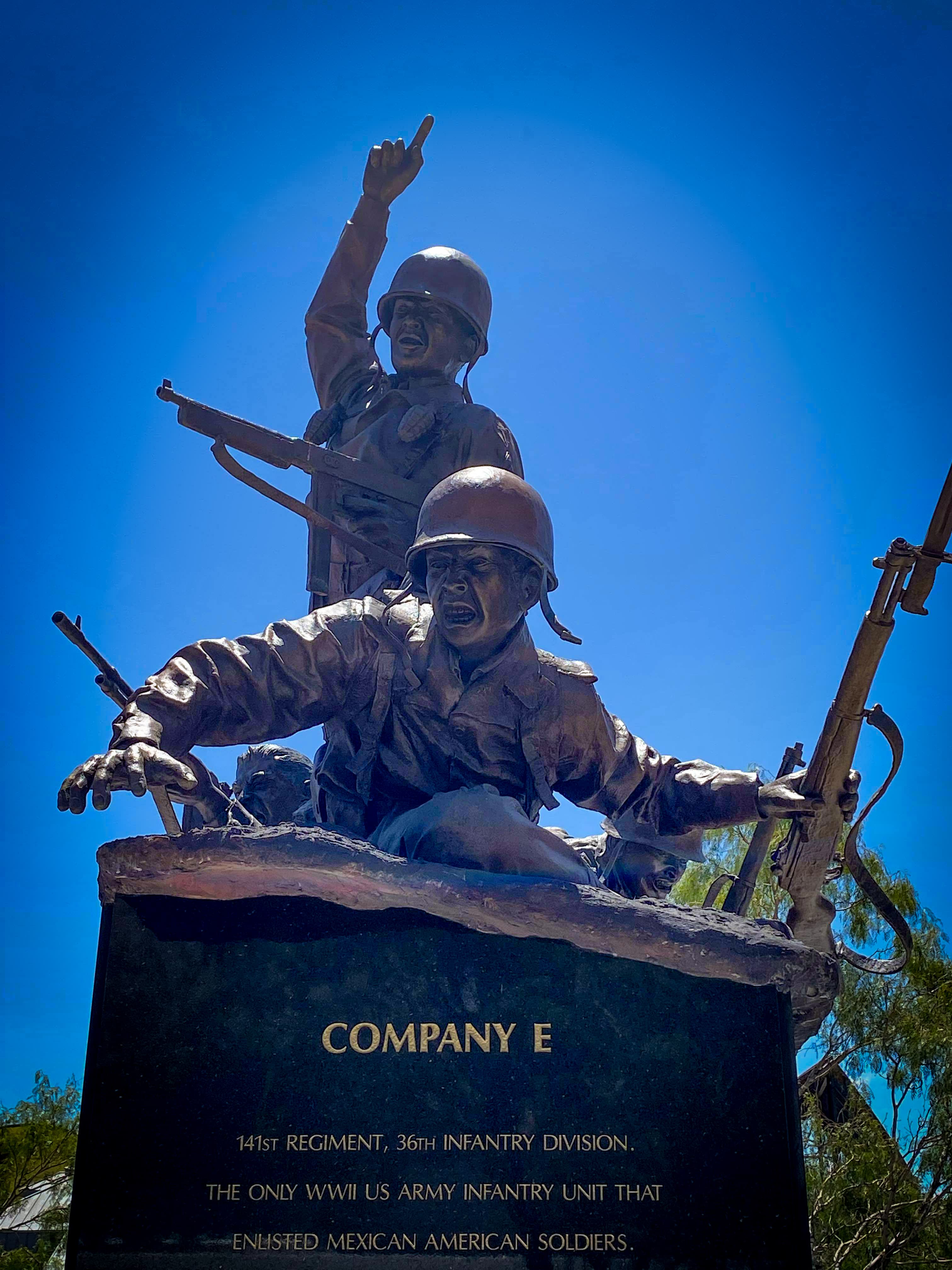
Company E Memorial in downtown El Paso, 2024. The city of El Paso moved the memorial to a more centralized location downtown and near El Paso’s minor league baseball stadium. Photo courtesy of Alex Mendoza.