 University of North Texas

Our project in animal ethics is inspired in part by traditional Jain practices surrounding the management of panjaparoles or animal sanctuaries. We have partnered with the Microsanctuary Resource Center (MRC) to learn about the philosophy behind “microsanctuaries” or small-scale facilities dedicated to farm animals and other animals not typically counted as companion animals. Recipients of MRN microgrants manage their sanctuaries according to strict ethical principles regarding the autonomy and agency of animal residents. In the interview below, we meet Astrid Reusche, founder of The Rooster Project.
In her Rooster Manifesto, Astrid states that a rooster’s “existence is a problem to be solved.” In an economic system that privileges growth and productivity, a hen “is cherished, fed, sheltered. Her existence is justified by output.” But “for every hen, there was once a rooster. And the rooster was erased.” Astrid’s work at The Rooster Project is part animal sanctuary, part art project, part educational resource, and part an effort in activism to change the system that supports the routine culling of roosters.
In our conversation with Astrid, we learn more about her work and the ethical values that inform her approach to animal rescue.
This interview was conducted by Leah Kalmanson for the Bhagwan Adinath Animal Humanities Initiative in partnership with the UNT Oral History Program. It has been edited for length and clarity. All photos courtesy of Astrid Reusche.
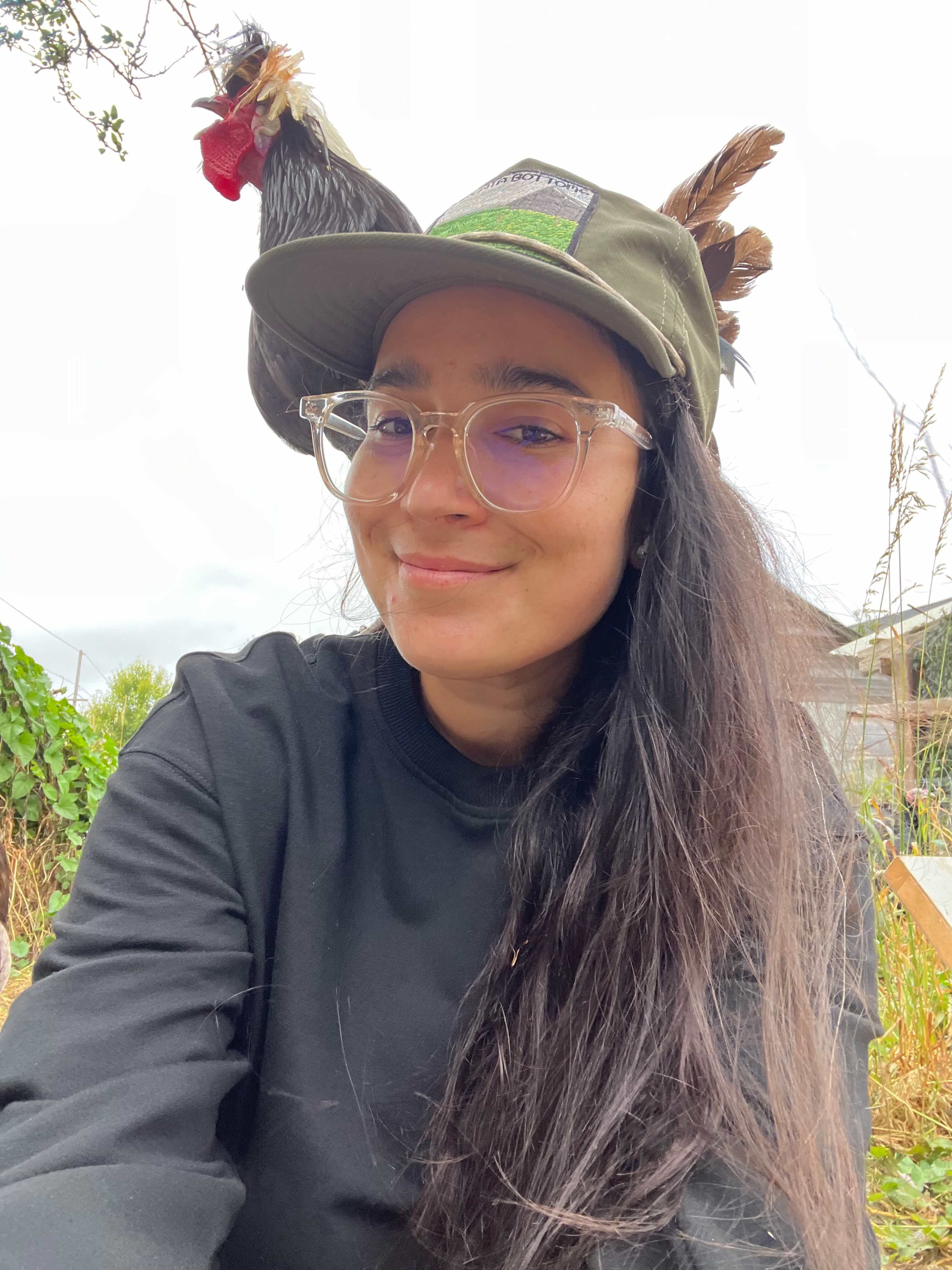 Astrid Reusche: I was born in Lima, Peru, very far from here. I'm in Northern California now, in
a very rural area. There's not a lot going on, which I like—you know, the simple life,
no traffic. And I also really love the weather here. It's always cold—our summers
are in the 60s. It's really beautiful, but it also rains a lot, and that brings a
bunch of problems when you're trying to rescue animals and have them be safe and happy.
Astrid Reusche: I was born in Lima, Peru, very far from here. I'm in Northern California now, in
a very rural area. There's not a lot going on, which I like—you know, the simple life,
no traffic. And I also really love the weather here. It's always cold—our summers
are in the 60s. It's really beautiful, but it also rains a lot, and that brings a
bunch of problems when you're trying to rescue animals and have them be safe and happy.
[Growing] up in Peru, my whole life, I grew up speaking Spanish, and my mom sent me to a French school, so I speak French, as well. Eventually, my mom and sisters moved here, and I followed them. I ended up coming initially to the Bay Area, and then I moved up here to go to Cal Poly Humboldt, the big university here in Arcata. And I graduated [with a degree] in psychology in 2015, and then I never left. [Later] I decided that psychology wasn't my calling, and I went back to school, and I graduated last semester with a BFA.
I think what inspired The Rooster Project is the fact that I decided I wanted to be an artist, and I wanted to create something that wasn't very traditional. I cared about rescuing animals, and it was something I was already doing. I thought, “I'm not going to paint anymore, and I'm not going to [pursue] these very traditional methods. I'm going to create this living artwork.” And that's what I presented as my final project—the Rooster Project.
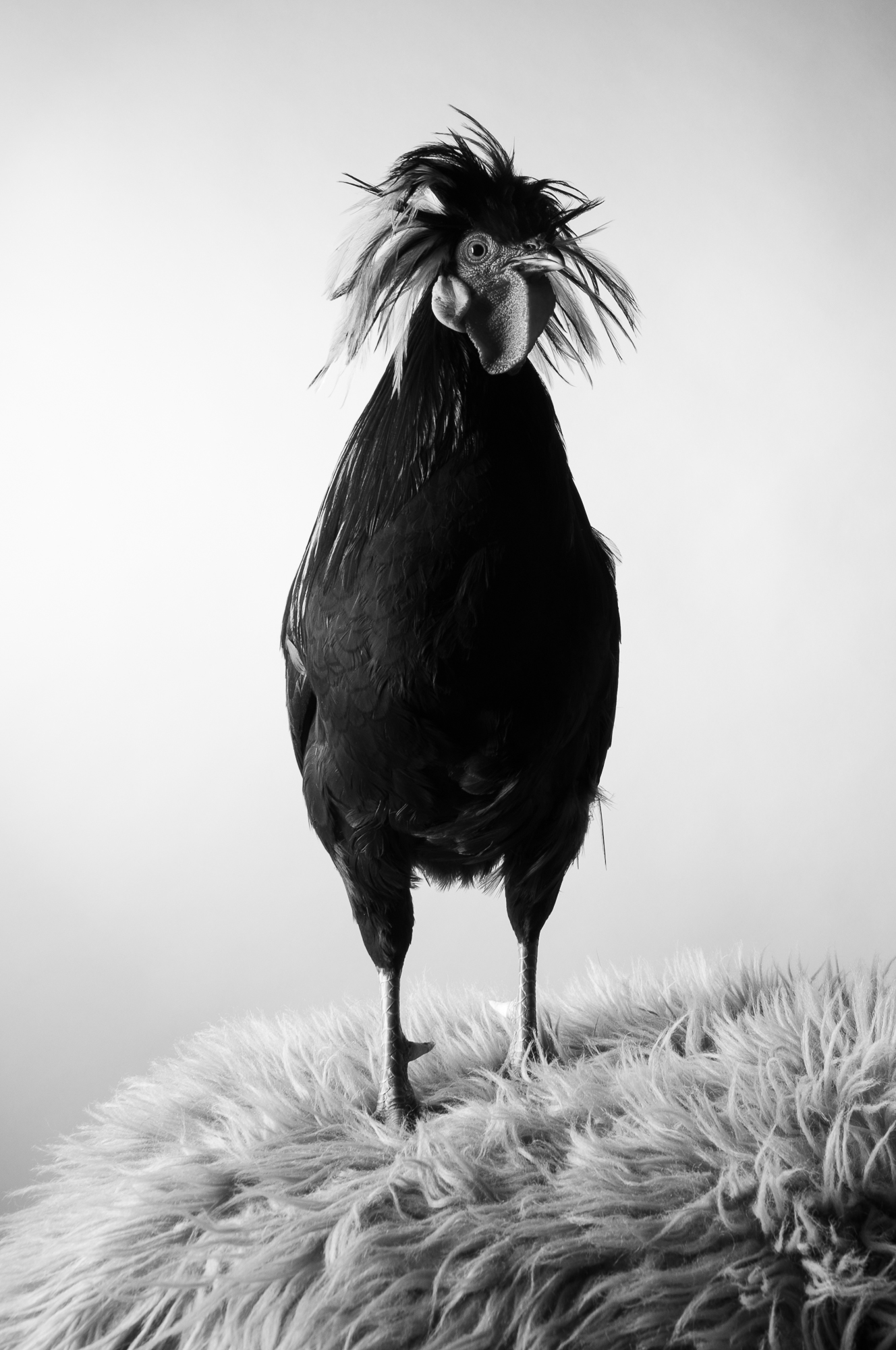
Some people ask, “Is this art?” [In my presentation for my BFA] I made the case that it was. And, I graduated! So, my teacher believed in me. There's a sector of art called land art or earth art, which is site specific. You have to go there to experience it and absorb it. You can't put in a museum unless you take pictures of it and display them. And it's meant to weather the environment. If you can maintain it, it will last forever; or you can just let it decompose. But I am maintaining [my project], so it's alive and well, and people can come see it if they want to…. It's very conceptual.
Leah Kalmanson: That’s fascinating. Tell me a little bit more about how you manage the art installation aspect of this—that is, if someone visits, what do they do and see?
AR: There's a couple parts to the question. [First], there's the way I presented this [for my BFA] last semester. [There’s] what I documented. I took pictures, first of all—I took pictures of the process of me building it, because I built everything myself. [There’s] also where I sourced everything. I think it's important, because I really care about sustainability. So, it was kind of a community project. Even if people didn't believe in my project, I put out the notice that I needed materials—whatever you can donate, or whatever you're going to throw away, let me come get it and I'll make something out of it, you know? So, I built [the sanctuary] out of all these materials that were meant to go to the landfill, basically. [But some of these] people would laugh at my project—like, “Roosters? What are you talking about?” And, I'm like, well, you're part of it, because you are donating materials.
So, I presented that aspect of it, and then I presented the pictures of how I built it. And then I presented the stories, because each rooster came with a story. Some people didn't want to hear the stories, because they're kind of sad…. It's hard to connect with the animals that we've enslaved in a way, right? [But] I presented the facts—a lot of people didn't know that roosters are killed. Usually, when [roosters] are a day old, they'll be killed. And the way they [are killed] is very, very graphic, and very horrible. So, it's always hard to talk about this with people, because that's when people just kind of look away, and they don't want to engage with your project. I made sure not to use anything too graphic, and to talk about it in a very engaging and relatable way. And even people who like don't care about the issue really connected with it. And they told me how they didn't know any of this happened. They just weren't aware of it.
And [second], there's the aspect when people come [visit the sanctuary now]. I've had people, friends, come experience the sanctuary. I wrote a manifesto. I felt like I needed to write something important. So, a manifesto was my way of doing it. So, I show it to people. I have a website, with my statement of purpose, and basically my whole statement is that this is a space of radical acceptance. I don't feel like these animals need a purpose to be alive. I just provide that safety, so they can be alive and enjoy their lives as they please.
I think a lot of people think that these roosters are in love with me, that they love me because I'm their savior or something. But no! Half of them want nothing to do with me. Half of them are, like, happy, and they don't want to be touched. They'll take a treat—that's it. They draw the line there.
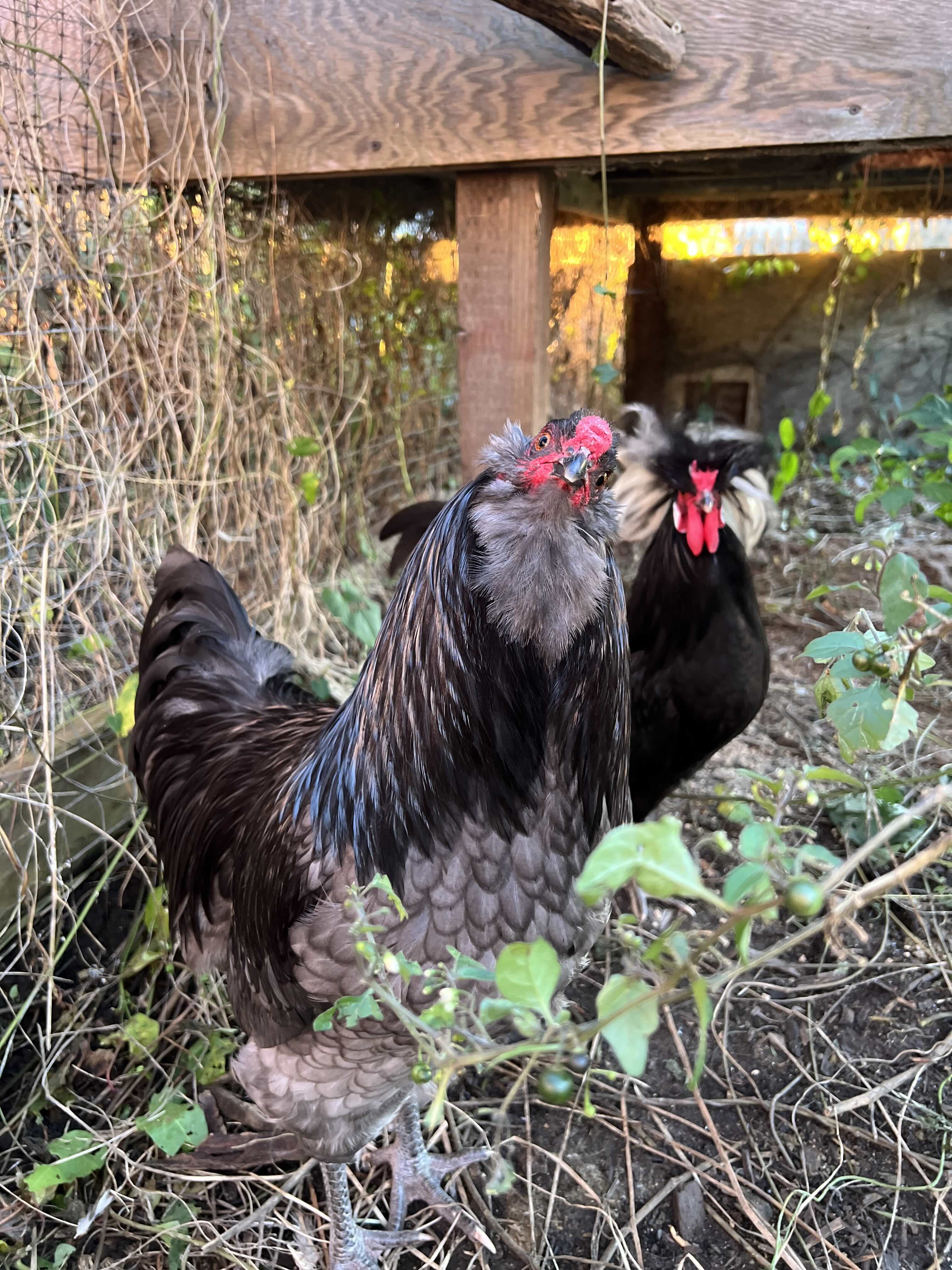 And this is a space where they can live their lives as like. So, yeah, a lot of people
don't understand that. This is not a petting zoo, right? [Visitors] don't come here
and get to poke and touch and exert their will onto other living beings…. So, yeah,
that's been the experience so far.
And this is a space where they can live their lives as like. So, yeah, a lot of people
don't understand that. This is not a petting zoo, right? [Visitors] don't come here
and get to poke and touch and exert their will onto other living beings…. So, yeah,
that's been the experience so far.
LK: Before you started The Rooster Project, by way of your art degree, did you have any other background in animal rescue work or animal sanctuary work?
AR: Yes, I've always rescued animals. I have two dogs that I've rescued. Before I started the sanctuary, I had rescued a rooster, and I think that was the rooster that changed everything for me. In my community, there are a lot of Facebook groups for people in agriculture, because there are a lot of farmers here. And someone posted, “I have this rooster. If nobody adopts him, we're killing him tomorrow. He's six months old.”
And I was, like, “Oh, my God, why did I see this now? Now I'm complicit! Now I need to do something.” So, I told her that if nobody takes him, then I would take him. I thought: I'll figure it out. I'll make him a home. The next day, she [came to deliver the rooster], and I didn't know that this was a little boy's rooster. Her son came, and he was so devastated. He was so devastated, tears in his eyes. He was about 10. He was holding [the rooster], hugging him, and he was so heartbroken. I told him, you know, you can come visit…. I felt so bad, right? And, his mom was, like, “Oh, He'll get over it.” And then I took the rooster…. It felt so bittersweet. [I was] saving him from death, but I was taking him away from this boy who really loved him.
And, also, why is this acceptable? Why? If this was a dog, if this was a cat—these animals that as a society we love so much—this would be frowned upon. Nobody would think that this woman's behavior was acceptable. Killing [this animal] as an ultimate solution would not be acceptable. And I was just so upset about the whole thing, and that's when I realized there's so many people like her who are posting every day on social media saying, “My roosters have nowhere to go,” right? Many kill them, because that is what they do…. I thought: I need to start a sanctuary for these roosters, because who else is going to take them?
But, then, it's hard. [For example] this other woman, she got my number, and she runs a petting zoo, and she's always hatching chicks. Like, always. The amount of chicks she hatches is wild. She'll text me every week saying, “I just hatched 50 roosters. Can you come take them?” And, that is just unsustainable. I mean, in my capacity as a microsanctuary, I cannot take 50 roosters a week. It makes me so sad, and it makes me so angry. As a petting zoo, she wants the chicks, you know? That's what the kids really like—the little chicks. So, she's constantly, constantly breeding them. It breaks my heart—not being able to help every roaster….
I [also] foster dogs. I've fostered other animals. Our shelter here, our animal shelter, is always at capacity. It's really small, and they don't really work with roosters or farm animals. I'm always checking to see if there's a rooster, and I never see one. I think people just either kill them or they abandon them, right? There's spots here where people dump roosters….
LK: How many roosters do you have now?
AR: I have 12 roosters.
LK: And what do you think is your capacity? How many could you take?
AR: I don't want to go over 20. Part of having roosters, and having them live in a flock, is about how they exist with each other. Integrating a new rooster is always scary, because I don't know if [the current roosters] going to like [the new one] or not. You don't know if they're going to accept him. It takes a lot of patience. You can't just throw the rooster in there and hope for the best. You have to assimilate them, and allow them to see each other, but without contact, so they can't fight. And, so far, it's always worked out, except for this one rooster [who wasn’t accepted by the flock], who became a house rooster for a while. He loved life!
[Once] there was this Buddhist group here in Humboldt that traveled to a San Francisco meat market, and they rescued 10 hens, yeah, and they needed someone to take them in. So, I rescued [the hens], and then the [house] rooster fell in love with them! He wanted to live with them. But I have them separate. [As long as] the roosters never see the hens, they don't fight over them. You'd be surprised how non-aggressive [roosters] are to humans. People think [roosters] are aggressive, [but] they are protecting the girls. If you take away the girls, then suddenly [roosters are] like puppies! They follow you everywhere, and they want to hang out with you….
LK: It’s possible the Buddhist group was performing what’s called a “life release ceremony.” It’s a practice that goes back many centuries, where Buddhist practitioners buy animals that are destined for slaughter and release them.
AR: The conditions these chickens came in were rough. They had bumble foot. They smelled horrible. The first month, they were scared to go on the grass, to touch the grass, because they had lived in cages their whole lives. They were so scared to come out of their chicken coop. Getting them to trust people, to trust their environment [was challenging]. [Now], they're doing so good. They're doing so good now!
LK: Tell me a little bit about the day-to-day operations at your sanctuary.
AR: In the morning, I wake up, and I let the chickens and turkeys out, because they're inside the coop. We have lots of raccoons, skunks, and foxes, [so] safety is definitely a priority here. The chickens are free fed, so they can eat as much as they want. They have feeders that I fill up, that hold five gallons at a time, so I check to make sure they're full and there's enough water. I also check that they're fine, right? Sometimes, we've had rats chew their chicken coops, so I make sure that there's no rat poop, and there's no leaks.
Then I go let the turkeys out, and they are on a diet. I feed them a portion in the morning and a portion at night. Two of the turkeys are broad-breasted turkeys. Those are the Thanksgiving or Christmas turkeys. They're not compatible with life…. Basically, their bodies have been bred to grow as big as possible, as fast as possible. The have a funny walk, they have all these issues, but they're happy. But—they're on a diet. Because if we were dealing with those issues and obesity on top of it, that would be really bad.
This is an ethical question. Some people think that it is cruel to try to keep them alive, because they're just so incompatible with life…. They get pain and their joints and stuff. I've done a lot of research on this. There are sanctuaries that have 10-year old broad-breasted turkeys. It shows that if you care, and if you manage their diet, you can keep them alive for a long time
Last year, I had a broad-breasted turkey who was 4 years old, and I had to put him to sleep, which was a horrible, horrible decision. I spent a lot of money on treatments, and a lot of time and resources to try to keep him from being in pain, but he couldn't walk anymore. It was really sad to put him to sleep. To me, it like felt like the ultimate betrayal, because I’m the person that loved him the most and the person that he loved. I had to take him to the vet, and I had to hold him, and it was awful….
But, I think that they want to be alive, and I think that's important. They are very happy. What's lacking, is the research. There's no research on how to maintain a turkey’s life. There's [just information on] what to feed them so you can send them to slaughter. [There’s no research on] what diet [is best for longevity. [I just try to] feed them fresh veggies, try to keep them moving. They're so heavy that they don't want to walk, so I spread their food around to keep them exercising. And hopefully they do live a long life, pain free.
If it does come to a moment when they're suffering, I will always do the hard thing, which is to put them to sleep. But I hope it doesn't get to that point….
We also have two pigs. They are definitely on a diet! They love to eat. We feed them pellets [and also veggies from] a Chinese buffet down the street from us. They give us all their veggies, all the parts they cut and they don't use. The sustainability of it is really great, because that was waste, [and now the pigs are] eating it. I think my next project, for next year, will be composting the pigs’ poop and putting it in our garden beds. I want to grow food for them, to create this kind of cycle—their poop is going to break down, it's going to feed the worms, and it's also going to feed the plants. And hopefully I can create a full-cycle composting system. That's what I want to put my energy into this winter.
LK: When you mentioned that the broad-breasted turkeys “want to be alive,” I thought of one of the most famous quotes from the Jain sutras: “All beings are fond of life, like pleasure, hate pain, shun destruction, desire life, long to live. To all life is dear.” It’s such a simple statement, but it’s the foundation of so many Jain practices. I shared with you the story of King Megharath that inspired some of my work for this animal ethics project. That’s the story about the king who has to decide whether to help the pigeon who’s fleeing a hawk, or help the hawk who’s starving and needs meat to survive. Just recently, in the course of doing my first interview, I learned about the practices surrounding wildlife rescue work for predators, and some of those practices involve “live-training” with prey before the predators can be released into the wild. And that was, honestly, very difficult for me to learn about. Because my first reaction was to think, “I could never do that.” But then, I thought, “What if I find an orphaned fox kit or coyote pup? Would I leave it, or would I take it to a rehabilitator?” I can’t imagine walking away and leaving it, probably to die. But I also now know that, if I take it to a wildlife rescuer, it will be live-trained to confirm that it knows how to attack and kill a rat or rabbit.
Here in the microsanctuary community, everyone who receives funding agrees to follow a principled approach to the sanctuary work, which involves being vegan personally and also implementing certain ethical guidelines regarding animal individuality and autonomy. I’m curious about any times you’ve faced a tension between these principles and the day-to-day realities of animal life.
AR: Oh, my God, I've been thinking about [the King Megharath story] ever since you emailed it to me. I, I did read the whole story—of him eventually giving his own flesh [to feed the hawk]. I'm such a baby, I [thought] I could never [do that], [but then] I was thinking that I kind of do that in a different way—a sacrifice in a different way. For example, I want to go visit my mom. She lives in LA. And it's so hard to go out of town when you have a microsanctuary, right? I have to find different people, because there are people who will watch my dogs and my cats, but they won't watch the turkeys because those are “scary.” And so then I have to find someone else for the chickens and the turkeys, and I have to find someone else to go to the Chinese buffet to get the veggies, because we have a contract with them, and bring [the veggies] over to the pigs. So, I've added all this work and stress to my life, and not only is it unpaid, but half of my paycheck goes into it. But if I wasn't here, what would happen? These animals wouldn't have a home, and they would probably be dead, you know? So, yes, that is my own personal sacrifice, and it makes me happy. But it also creates a lot of burnout for people in this industry. I wish one day I could have lots of volunteers.
[In response to the Megharath story] I also thought: I do have cats. I've rescued 6 cats. And they do eat meat.
LK: Mine do, too. I think about it a lot.
AR: I think about it, too, especially the more I know about the pet food industry. I met this woman who has a sanctuary, as well, and she told me how she rescues horses from auction. Racehorses—the moment they pull a muscle or they're not perfect anymore—are sent to auction. And then they get sold for $1, and they become pet food…. And even that—that goes against a lot of sanctuary principles, [where there are] rules against buying animals…. It's a hard thing, it's a hard thing to decide. I sometimes I go buy food for my turkeys or my chickens [at farm supply stores], and I see all the chicks they are selling, and I wish I could just save them all. But, you don't want to pay them to keep breeding these animals. It’s such a hard thing. There's no right answer, I think.
LK: Even though Jainism seems to advocate extraordinary efforts to save a single life [like King Megharath’s sacrifice], it also takes a very frank look at nature. Even eating a vegetable is killing a living being. So it’s always a matter of making a judgement call. And Jainism is clear that to be incarnated, to be embodied, involves unavoidable violence. So, it’s a question of how much violence, and in what context. I think your sanctuary is very much in the spirit of this. Maybe you can’t save every rooster, but you’ve got these 12 roosters, who are very happy.
AR: You know, there's this mug I had for a long time, like 10 years, and it was the most generic mug. And it said: “Be the change you want to see.” And that never clicked for me—a generic quote, whatever! But one day I looked at it, and I realized: “I have to be the person rescuing these roosters. Nobody else is doing it.” And people think, to this day, that I'm crazy. People laugh at me when I tell them about my project. But I have to do it, because that's the change I want to see in the world. And hopefully other people will see it, and people will learn, and the more they know, the better choices they make. It’s just funny—that you can look at the same quote for your whole life, and it makes no sense, and one day it just makes perfect sense.
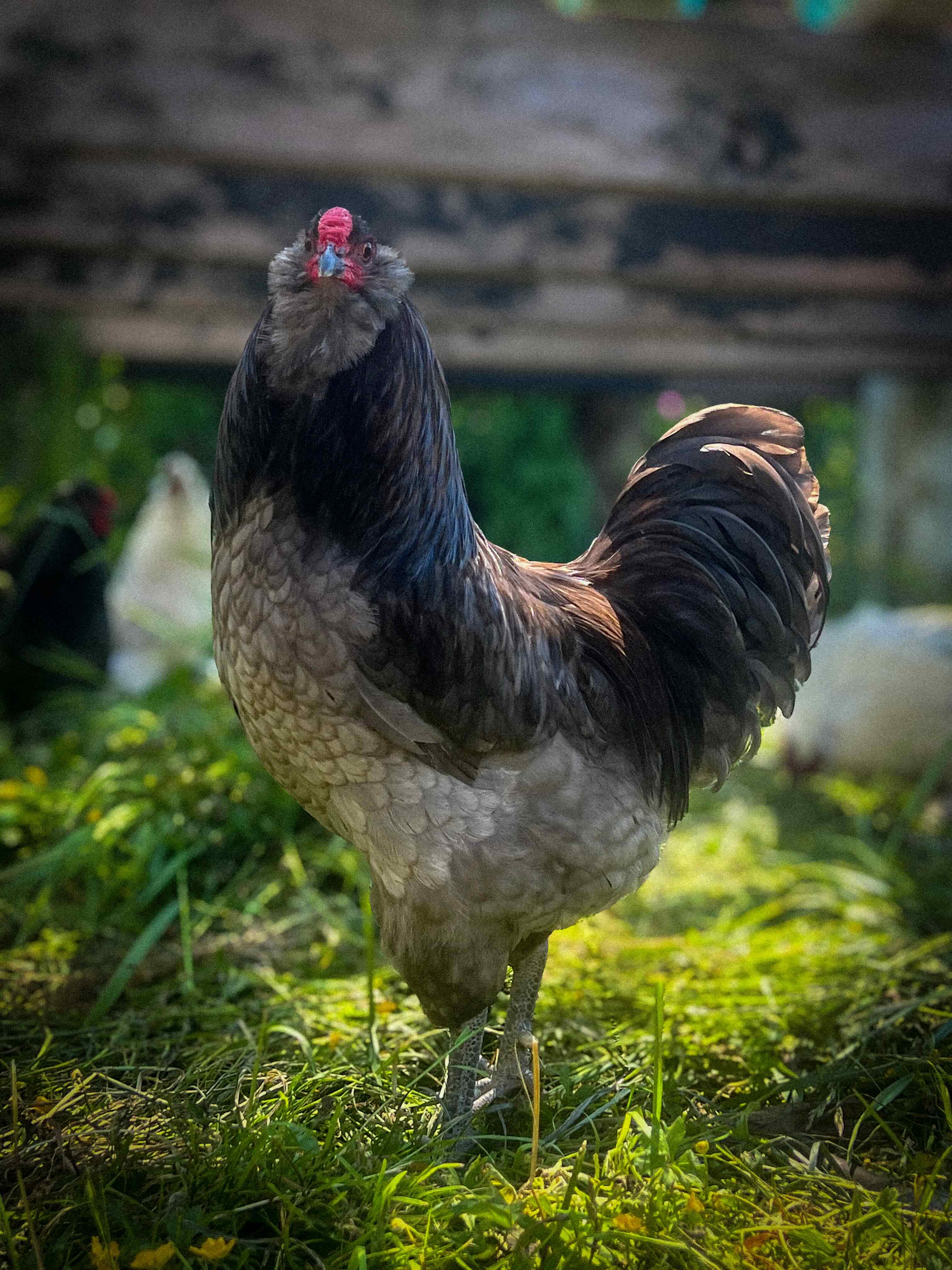
Photos courtesy of Astrid Reusche.