 University of North Texas

Jewish Studies Courses
Coming Fall 2026

Fall 2026 Courses
PHIL 3560 Judaism
Examination of the beliefs, practices, laws, and movements in Judaism from Biblical
times to the present. Explores the diversity and multiplicity of Jewish lives, identities,
and experiences in relation to other religions, cultures, and societies, as well as
contemporary questions of prejudice, tolerance, and inclusion within and beyond Judaism.
PHIL 3510 Hebrew Bible
Philosophical and ethical concepts of the Hebrew Bible compared with ancient pagan
thought and subsequent Western culture. Concepts discussed include creation, revelation,
holiness, faith, covenant, prophecy, idolatry, chosen people, justice, mercy, truth
and peace.
HIST 3308 Ancient Israel
Survey of the Hebrew people’s attempts at early state formation from their origins
to the Persian period (ca. 3000 BCE–ca. 500 BCE). Major themes include early incarnations
of Israel as a state bordering stronger powers, notions and problems of state formation
in the tradition of “Western” thought, the interplay between Jewish monotheism and
assimilation with neighboring polytheistic cultures, and how this interrelationship
informed Jewish notions of leadership and community. Concentrates on primary sources
and on the most influential modern scholarship on Hebrew culture, ancient Israel,
and its neighbors; also explores the use of archaeology and other non-literary sources to
address the basic issues of the course.
HIST 4385 Nazi Germany
Comprehensive, sophisticated account and analysis of the Nazi period in German history,
exploring issues related to the content and implications of Nazi ideology, the role
of Hitler, the complicity of elites such as Junkers, the military, the churches and
big business. Examines the origins both of the Nazi movement and of the conditions
in Germany that led to the movement’s rise to power. Analyzes the consequences of
the implementation of Hitler’s policies in the forms of genocide, military conquest
and defeat.
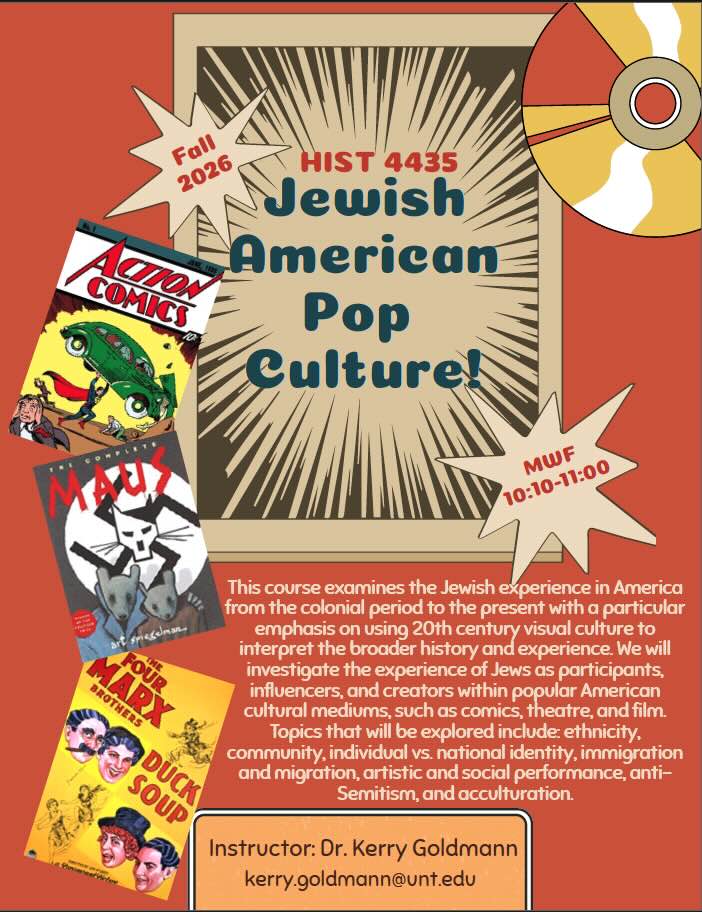
HIST 4435 Jewish American Pop Culture
This course examines the Jewish experience in America from the colonial period to
the present with a particular emphasis on using 20th century visual culture to interpret
the broader history and experience. We will investigate the experience of Jews as
participants, influencers, and creators within popular American cultural mediums,
such as comics, theatre, and film. Topics that will be explored include: ethnicity,
community, individual vs. national identity, immigration and migration, artistic and
social performance, anti- Semitism, and acculturation.
ENGL 3370 The Bible As Literature
Considers the variety of literary genres and narrative strategies in the Bible and
the historical contexts in which its various writers wrote. Books of major literary
interest or influence selected both from the Torah, Prophets, and Writings of the
Hebrew Bible and from the New Testament. Some biblical readings may also be paired
with works of literature in English influenced by the Scriptures. No acquaintance
with the Bible is assumed.
GERM 4314 The Third Reich
Overview of the history and culture of the Third Reich (1933-1945) and the German
postwar period until the foundation of the Federal Republic of Germany and the German
Democratic Republic in 1949. Taught entirely in German.
THEA 4395 Theatre and the Holocaust
The exploration and examination of performance and the arts as reflections of the
experiences of people during the Holocaust.
Spring 2026 Courses
PHIL 2070 World Religions
Philosophical and social dimensions of Hinduism, Buddhism, Taoism, Judaism, Christianity, Islam, and Humanism. Emphasizes the diversity of religious experience and traditions.
PHIL 3130 Philosophy of Race and Racism
A philosophical analysis of the meaning of race and the problem of racism. Examines the origins, concepts, and nature of race; the nature of racism, systematic racism, and racial oppression; and how racial justice and anti-racism can be achieved.
PHIL 3510 Hebrew Bible
Philosophical and ethical concepts of the Hebrew Bible compared with ancient pagan
thought and subsequent Western culture. Concepts discussed include creation, revelation,
holiness, faith, covenant, prophecy, idolatry, chosen people, justice, mercy, truth
and peace.
PHIL 3600 Philosophy of Religion
Examines the concepts, belief systems and practices of religions. Topics include religious experience, faith and reason, arguments for God’s existence, the problem of evil, religious language, life after death, miracles, religion and science, and the conflicting claims of different religions.Jewish Studies Courses - Spring 2026
HIST 3470 History of the Israeli-Palestinian Conflict
Explores major historical elements of the Israeli-Palestinian conflict and the broader Arab-Israeli conflict. Foundations of Israeli and Palestinian national identities, major historical moments that have intensified the conflict, changing patterns of U.S. foreign policy toward the region, and ways in which religious commitments inform approaches to ongoing conflict.
HIST 4215 Jews Under Greek and Roman Rule
History of the Jewish people from Alexander the Great to the spread of Islam; covers the Maccabean revolt, the Herodian dynasty, life in the diaspora, sects of Judaism, the ministries of Jesus and Paul, the Jewish revolts, early Rabbinic Judaism, and the development of Christian anti-Semitism. Readings include the Hebrew Bible, intertestamental literature, the Dead Sea Scrolls, the New Testament, Flavius Josephus and other historians, and Talmudic excerpts, as well as documentary sources.
HIST 4246 Imperialism in the Modern Middle East
The modern history of imperialism in the Middle East. Historical foundation concerning classic Islamic styles of empire and the history of European and Ottoman imperialism, as well as anti-imperial and post-colonial movements, in the past 200-plus years. Includes many contrasting arguments about empire and postcolonialism to give students a wider sense of the variety of issues, ideas and historical conclusions concerning this dynamic and influential region.
HIST 4360 Europe Since 1945
Economic recovery and subsequent stagnation, retreat from empire, popular culture, revolution of 1968, domestic politics, diplomacy, collapse of socialism and disintegration of the eastern bloc, European integration.
HIST 4390 The Holocaust, 1933-1945
European Jews and their destruction during Nazi Germany’s ascendancy; Jewish communities and anti-Semitism before the Nazis; institutions and processes of extermination; victims, including non-Jews; perpetrators; historical background.
ENGL 4660 Literature and the Holocaust
Study of literary responses to the Holocaust. “Canonical” Holocaust authors such as Primo Levi, Eli Wiesel and Anne Frank are read alongside criticism, theory, graphic novels, film and the works of lesser-known authors. Topics of discussion include the relationship between Holocaust literature and film, language and trauma, literature and genocide, storytelling and history, art and ethics.
GERM 4312 The Weimar Republic
Overview of the cultural life and artistic output during the Weimar Republic, the German state between 1918-1933. Taught entirely in German.
INST 4855 International Relations and Politics of the Middle East
Introduces students to international relations and politics of the Middle East, with focus on critical security issues. Surveys rise of the state system in the Middle East and crises of authority and identity. Examines Middle East regional relations and role of Middle East in international affairs.
WLLC 3400 The Holocaust and Film
Examines how the Holocaust has been portrayed in feature films and documentaries.
This course is taught in English.