 University of North Texas

This interview was conducted by UNT graduate students Jack Eudy and Zechen Wang for the Bhagwan Adinath Animal Humanities Initiative in partnership with the UNT Oral History Program. It has been edited for length and clarity. All photos courtesy of Helen Mar Parkin.
Zechen Wang: Helen, so thank you so much for joining us. We are participating in the animal ethics and oral history project, so your work is extremely important for our research. Please tell me a little bit about yourself, and how long you've lived in this DFW area, and anything else you would like to share about your background.
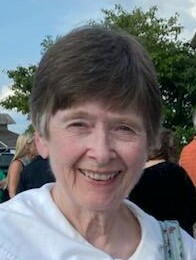 Helen Mar Parkin: Originally, I'm from the Northeast in Pennsylvania, and I moved here for the first
time in 1980 to take a job in this area. I met my husband, and then we moved away
to another state for a number of years. We moved back in 2000, so I really have been
in Texas since 2000. Most of that time, we lived out in the country in East Texas,
and we only moved back to Fort Worth last year. So, all this time, since 2005 when
I started volunteering on the DFW Wildlife Hotline, I've been able to do that remotely,
because you can do it at home. We have all the information on the internet that I
can help people with. So, it doesn't really matter where I am—I could be anywhere
in the country.
Helen Mar Parkin: Originally, I'm from the Northeast in Pennsylvania, and I moved here for the first
time in 1980 to take a job in this area. I met my husband, and then we moved away
to another state for a number of years. We moved back in 2000, so I really have been
in Texas since 2000. Most of that time, we lived out in the country in East Texas,
and we only moved back to Fort Worth last year. So, all this time, since 2005 when
I started volunteering on the DFW Wildlife Hotline, I've been able to do that remotely,
because you can do it at home. We have all the information on the internet that I
can help people with. So, it doesn't really matter where I am—I could be anywhere
in the country.
I'm not a rehabilitator. You probably know that. I'm just a volunteer on the DFW wildlife Hotline. My background is in art, not in wildlife at all. But I was always interested in animals. I took some advanced biology classes and was fascinated with animal physiology, and I always had pets as a child, and learned early on to care for and be kind to little animals, and so that's just something that I've always had. But when the opportunity came up to volunteer on the hotline, I was just fascinated by the idea and jumped on board.
In 2005, when my husband and I were living in Fort Worth, I saw an advertisement for a lecture by a woman named Bonnie Bradshaw. I don't know if you know that name. She's a wildlife rehabilitator. She was a raccoon rehabilitator in Richardson. One of the three people that started the hotline—Prudence Koeninger—is the only one really left who's running it now, but back then, Bonnie Bradshaw and Kathy Milacek were also involved in setting it up.
*Editor’s note: Readers can see our interview with Prudi Koeninger conducted in October of 2005.
Anyway, I saw a lecture by Bonnie Bradshaw, and just fell in love with the whole idea of caring for wildlife. And she told me about not only about the wildlife hotline, but about the Texas Master Naturalist program. So, I ended up taking classes on how to be a hotline volunteer from Bonnie at her home in Richardson for several weeks with some other people. And then, the following year, I joined the Texas Master Naturalist program, which, as you may know, is a broad program sponsored by Parks and Wildlife and also Texas AgriLife Extension. It's a volunteer program in which you learn all about Texas, all about the ecosystems, the animals, the plants, the geography, the climate, whatever. And so that kind of solidified my knowledge of animals. And so, I've been doing the volunteer work on the hotline for 21 years, since 2005. I think I'm one of the longest ones.
ZW: Can you share an example of a rescue that is particularly memorable for you in your 21 years?
HMP: The one rescue that really sticks in my mind is when the Master Naturalists were called upon in 2022 to rescue some egrets at a rookery in McKinney. There are a number of rookeries of egrets all around the metroplex, and what happens is, in the summer, when it's very hot and dry, the mother birds leave the nest frequently. These are nests that are way high up in the trees in the middle of neighborhoods. The mother birds leave the nest for long periods of time to find food and the babies are, you know, hungry and squabbling with each other and falling out of the nest, and they end up on the ground—and the mothers can't help them if they're on the ground. So, we got a call to rush to McKinney to help these babies—to find them, pick them up, and transport them to Rogers Wildlife in Hutchins, which is south of Dallas, where they can be cared for.
And that was a real heartbreak, because a lot of these babies didn't make it, and it was a real mess, you know, they had the droppings everywhere—it's just a very sad situation. But we were able to rescue many hundreds of them. Master Naturalists went in in shifts, and then I decided I wanted to volunteer at Rogers to help further. So, I got to feed some of the little babies and care for some of the birds. And that was quite wonderful, but it was a long drive for me, so I only did it for a few weeks.
That's the most memorable—the best memory I have, the most wonderful memory I have—of saving wild animals.
ZW: Regarding scenarios where it’s unclear whether someone should intervene, can you share a bit about that?
HMP: I've learned a lot since working on the hotline about what to do and what not to do, and when to intervene and when not to intervene. Now, if I find a spider in my house, I leave it alone. If I find a bee in my house, that's something else, you know—because a bee on the ground is starving, if it's not outside. So, it just depends what kind of animal it is. Scorpions, lizards—they go out. Spiders get to stay inside.
But I would say when I'm working on the hotline, I often encounter people who think they're doing the right thing by “rescuing,” but it's actually “kidnapping”—finding a baby animal outside which does not need help, a baby squirrel on the ground, a baby bird, a little fledgling that's fallen out. People think that they need to not only rescue them, but they call on a hotline and say, “I found this baby bird and I brought it home. What should I do?” And I'd say, “Well, the best thing to do is try to reunite it with the mother.” That's its best chance of survival. And they say, “Oh, well, I can't do that, because I just brought it home, and I'm 30 miles from where I found it.” So, it becomes an orphan, which was totally unnecessary.
So, a lot of what we do on the hotline is educating the public on when to intervene, when something does need to be rescued. The guideline is if that it's injured or orphaned—if it's definitely orphaned and you know the mother is dead—well, then it's okay to intervene and rescue it. But otherwise we always try to reunite.
People find a fawn in the woods, and think, “Oh, there's a fawn that's been abandoned by its mother.” No—the mother leaves it for a certain amount of time every day, because it has no scent, and it's safer if it's quietly resting in the woods, and she's foraging to find food. The same with baby rabbits—the mother only comes twice a day to feed them, and the rest of the time they are just out there in the open, in this relatively unprotected nest, because they have no scent, and the predators don't find them. A lot of times it's best just to leave them alone. We kind of guide people how to determine whether the mother rabbit is coming back. You can mark the nest. You can keep an eye on them. Keep the dog away. And after a week or two, they'll be old enough to hop on their own.
Sometimes people think it's a baby, when it's not—it's a juvenile. It looks like a baby. There are all sorts of things that we are trained to talk about. And, as wildlife volunteers, we have yearly refresher classes from experts who talk about these things, and remind us how we should be guiding people along.
ZW: Are there any other challenges you face, especially things that readers might not be aware of, that you want to share?
HMP: Sometimes the worst problem is that the caller is terrified of the animal and wants it removed immediately and wants somebody to come and get it. And if it's an injured animal, and they won't go near it, and won't touch it, and won't contain it, then it can't be helped. it's a tragedy when somebody says, “Well, there's a turtle with a broken shell, but I'm not going anywhere near it, because I'm afraid of wild animals.” You know, it’s just a turtle. It has no defenses, unless it's a snapping turtle.
Other people want to keep the animal. They don't realize they're kidnapping it, and they could be causing more harm than good, especially if they try to feed it something which is the wrong food, and it has a bad reaction and doesn't make it because it's just the wrong food, or the food they're feeding it for several weeks causes metabolic bone disease, and they become deformed and crippled and they die.
People just don't realize—they're well intentioned, they're kindhearted, but they don't know. It's so important to let them know that there are wildlife rehabilitators out there that can help. There's a website called Animal Help Now [link], which is a national website. You just go to that site and put in your zip code, and you can find rehabilitators near you. So, I always tell people, if they're outside our area, to go to that and find somebody and keep that website handy.
Another problem is when people call up and say, “There's a coyote in my backyard, and if you don't come get it, I'm going to kill it.” People just assume that all wildlife is a nuisance. It could be an opossum, it could be a raccoon, it could be a skunk—and they just want to kill it. I try to talk somebody down from that, and several times they say, “Well, you're not helping me,” and they just hang up.
A lot of what we do is try to help people understand how to coexist with wildlife. You know, they were here first. We're encroaching on their habitat. And they're not prowling the neighborhood to kill you. They're looking for the small animals. If it's a coyote prowling the neighborhood at night, that's not a concern—you just to keep your animals and your children safe. If it’s a mangy coyote prowling the neighborhood in the middle of the day, that's a different scenario. In that case, we have somebody we can call, Rachel Richter, who's the wildlife biologist for this area. The DFW Wildlife Coalition also has a mange team that is ready to help.
*Editor’s note: Rachel Richter is a wildlife biologist at Texas Parks & Wildlife for the Denton County area. See a full list of Denton wildlife biologists here.
So, it's really a challenge. Every call I get, I never know whether it's going to be somebody who just needs a referral to a rehabber, or needs to know how to reunite [the baby with its mother], or needs to put the baby back. If there's a duck in the backyard with eggs, then people want to know what to do. Nothing! The animal is protected by state and federal law. That's a migratory bird. You must do nothing. They may say, “Well, it's in my yard. It's trapped. It's never going to get out.” It is going to get out. They have wings. When they are old enough to fly, mother will fly them away. And if that doesn't work, you can open the gate and get your neighbors to help shepherd and guide them down the street to the green space where the water is. There are just so many possibilities. And that's why I love working on the hotline, because it's a different challenge with every call. And it's, it's gratifying no matter what, for the most part. I really enjoy helping the animals and trying to save little lives. That's what it is.
ZW: I grew up in a big city, so I feel like our lives are disconnected from wildlife. When I first encountered a coyote, you know, in my area, I felt so terrified. It's like a wolf, right? I don't know anything about it. Do you have an suggestions for a scenario like this?
HMP: We tell people that if it's early morning or early evening, which is the time when they're normally out, then you just use gentle harassment techniques. Make yourself look big, bang on a pot, throw little stones, turn the turn the water on, and scare them away. Give them the feeling that humans are not friendly, that this is not a good place to be, and they will move on. And, of course, you need to make sure there's no pet food around or any other attractants.
I can tell you another story. Years ago, I had a call from somebody who had an opossum in the backyard, and the opossum was prowling around. And she said, “I'm terrified. This looks like a big rat. I don't want this thing in my yard. You must come and get rid of it. It's really creepy and scaring me.” I talked to her for 15 minutes and told her all the benefits of having an opossum in your yard. It doesn't carry rabies, it doesn't dig, and it eats everything, including dead animals and anything else you don't want. And it's a charming little animal with no defenses other than 50 very sharp teeth and the ability to play dead, which is an unconscious response—when it's terrified, it faints, and it gives off a noxious odor, which smells like dead animals, and predators leave it alone since they think it's dead. So, after I told the person all of this, she said, “Oh, okay, well, that's all right. Then I guess I'll just let it go and wander through my yard and enjoy watching it.” I was just so gratified that she had changed her mind completely, because of what I told her. I said, “This is my favorite wild animal. This is such a wonderful, fun animal. I wish I had one in my yard.” And it worked, you know? She turned around.
I read that story [about King Megharath] in the notes that you sent. Also, when Prudence Koeninger was interviewed, I saw that she responded to that, as well. Since I'm not a wildlife rehabilitator, I'm never faced with that dilemma. I don't rehab carnivores, and therefore I don't have to live feed them the way Prudi does. That's a terrible choice to have to make, and I'm glad I don't have to do it. My perspective is that I care about all animals, and I'm sure you do, too. I don't want to have to make a choice, and I'm not forced to…. I care about every everything. There might be one or two spider species that I would just prefer not to have in my house. But other than that, there's no creature that I don't care about and want to see thrive. As far as that story goes for that never, I never have that dilemma, because I'm not a rehabilitator.
ZW: What's your suggestion, for this scenario, for the king?
HMP: I wouldn't be able to make a choice that way. I would have to release both animals and let them find their own food. I'm not going to sacrifice one animal for another. I just can’t do that.
ZW: I think this is also why the king cuts off his own flesh, because he won't sacrifice the pigeon, and he wants to create balance between the hawk and the pigeon.
HMP: What did he do?
ZW: In the story, he takes a knife to his thigh and tries to cut off a portion that's equivalent to the pigeon. And, in the original story, he continues to do this, because the scales keep saying that the pigeon is heavier. It's eventually revealed that there are two spirits who were testing him.
HMP: I didn't read that far, I guess! I didn't know about that conclusion. The rehabilitators that I know that work with raptors have a source for frozen mice, and they keep them in the freezer, and then I guess they thaw them and feed them. They don't feed live animals. I've never known anybody that did that. They’re too kindhearted, I guess. They just feed frozen animals, which is bad enough, but I just can't see feeding a live animal to another live animal. That's really courageous, what the king did. I wouldn't be able to do that myself.
Jack Eudy: I saw your interview with Rug Hooking Magazine, and I I saw some of your art—and it's beautiful, by the way! I was curious how you think your background in art maybe affects how you see nature and animals, or vice versa. Has your work at the hotline affected your art at all?
*Editor’s note: Readers can see examples of Helen Mar’s artworks in her 2023 interview at Rug Hooking Magazine.
HMP: I was an art history major and then got a degree in art conservation. I was a conservator. I restored paintings for 40 years, and that's when I retired. I was looking for something that would engage my attention and interest as much as art conservation did, and that's how I ended up with rug hooking, because it’s a wonderful craft which combines many of the things I liked about conservation.
As far as how it relates to my wildlife interest, I don't know that it does. I've hooked a number of rugs [depicting] animals—you know, dogs, cats, birds—and I lavish attention on every detail, because I just love doing that. And one thing I do when hooking a rug about an animal or anything like that—I try to create a back story. The story of the rug behind me is that’s it’s an illustration from a Grimms’ fairy tale, and it has its own back story.
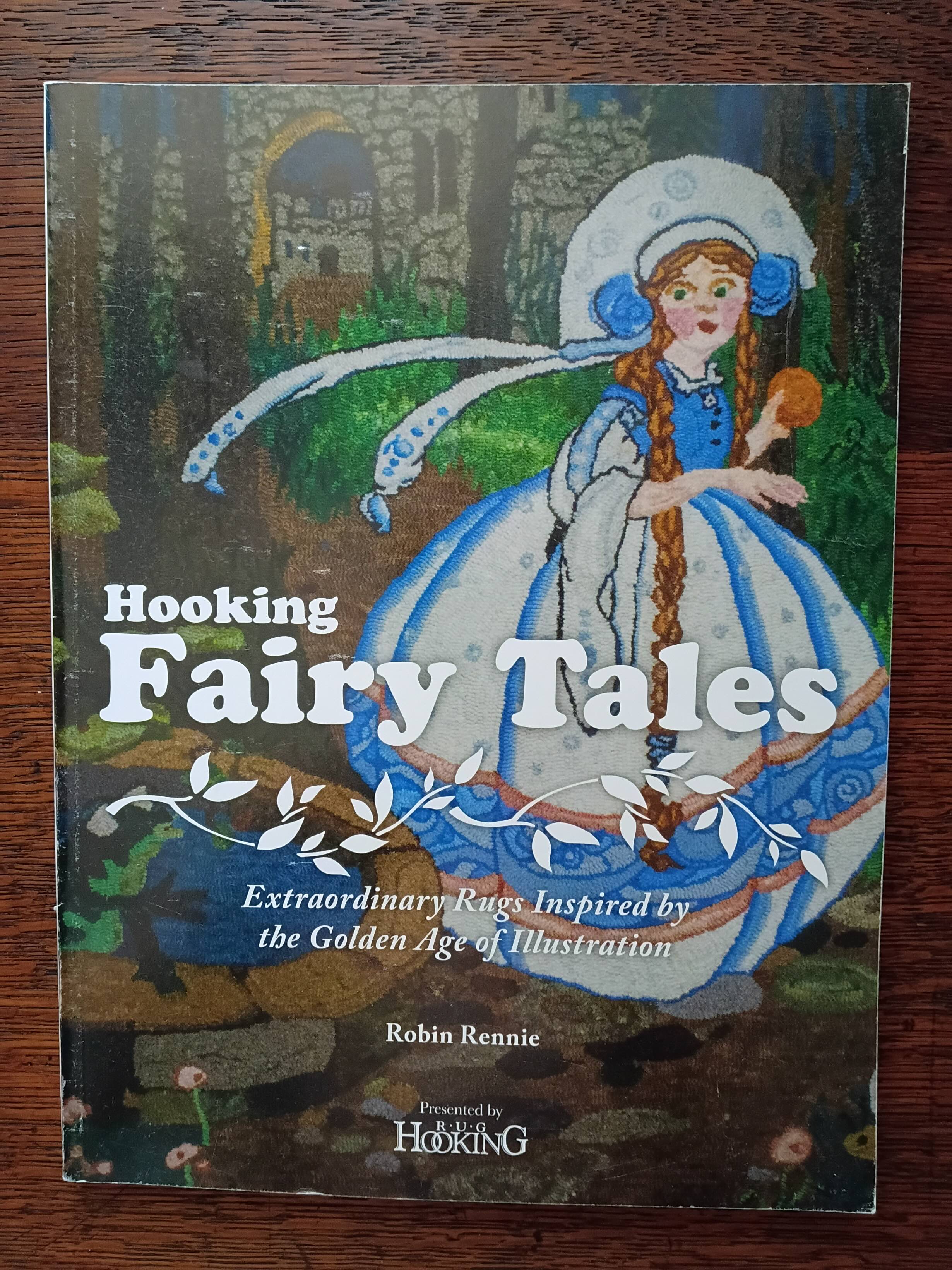 *Editor's note: The rug that Helen Mar mentions here appears in Hooking Fairy Tales: Extraordinary Rugs Inspired by the Golden Age of Illustration. This book features a collection of rugs hooked in 2021 by certified McGown rug-hooking
teachers around the world, which toured the United States as an exhibit for several
years.
*Editor's note: The rug that Helen Mar mentions here appears in Hooking Fairy Tales: Extraordinary Rugs Inspired by the Golden Age of Illustration. This book features a collection of rugs hooked in 2021 by certified McGown rug-hooking
teachers around the world, which toured the United States as an exhibit for several
years.
I have another rug that I worked on which showed a couple of Canada geese standing in a frozen field, and as I was working on it, I decided that these geese were unable to find food in the frozen field, and so I created a stormy sky to show how the storm was moving in from the north, and the geese were looking in this direction, which I decided was south. And so my back story was that they were starving and that they realized it was time to move on because the storm was moving, so they were getting ready to fly away. By doing that, I developed a connection with these birds. I love them. I felt so strongly for their story that I had created, and so it allowed me to lavish more and more attention and detail on them as I was working, and I created what turned out to be a prize-winning rug. It was a joy to work on, because I could identify with the bird story, and I've done that on several other rugs. Maybe that's the connection.
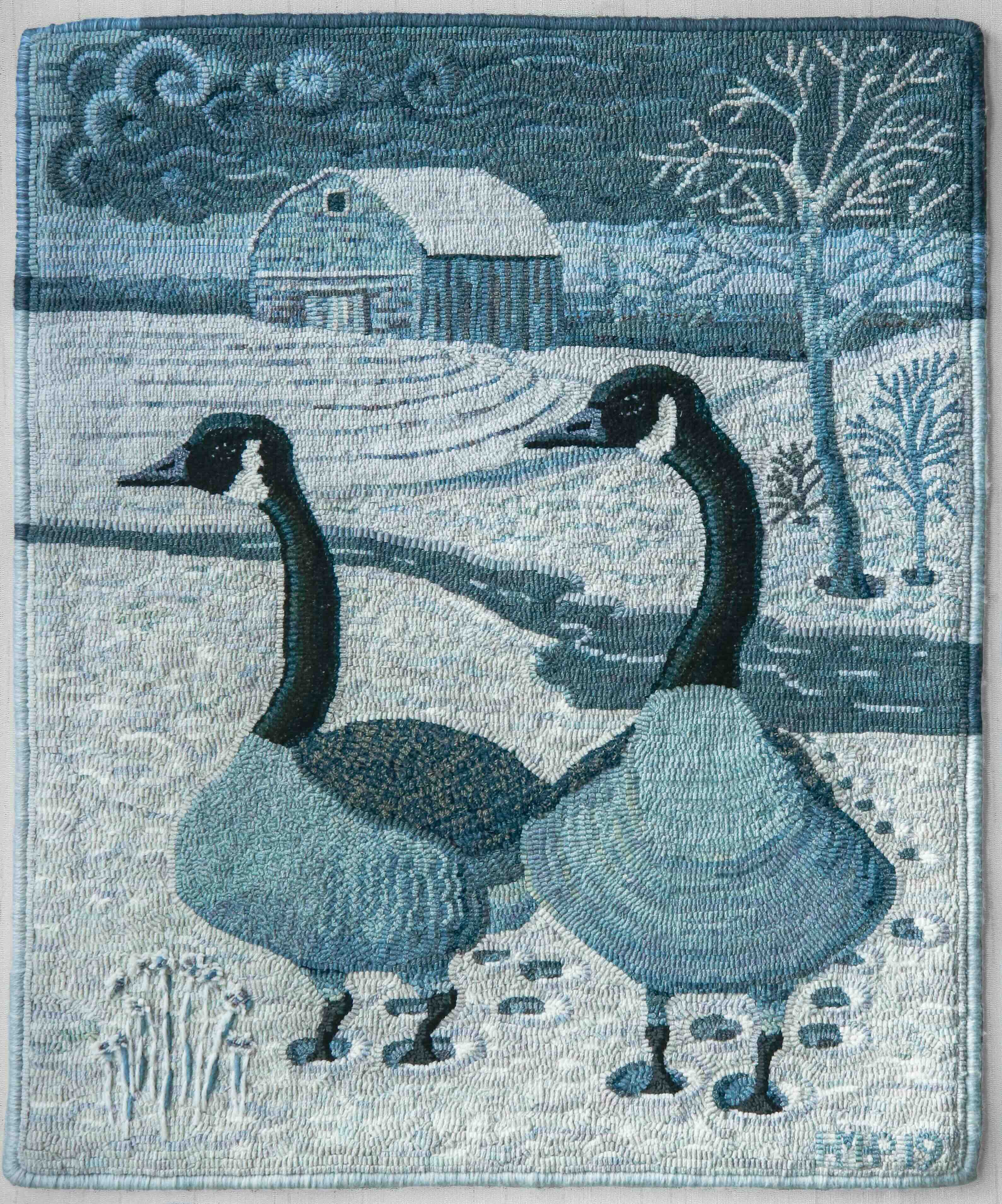
Canadian Snow Geese, designed by Jane McGown Flynn, hooked by Helen Mar Parkin, 2019.
JE: I think that's a beautiful connection. I saw a picture of the goose, and I can say that the love does come through for the geese.
You touched a bit on this during Zechen’s questions, but I guess I was curious a little bit more, when you have people on the line asking about coyotes or other things that they want to remove, what is your approach to try and get them to not do that?
HMP: My first question is always—what is the problem? Because people call up hysterical and frightened and want something done. And I'll say, “No, just tell me what's the problem.” And they'll say, “Well, the coyotes are in the neighborhood, killing all the pets,” which they don't have any basis for. But a pet might have disappeared, and they naturally assume that it could have been some other wild animal. But I always try to get the story. What's going on? When do you see the animal, and what is it doing? What's its behavior? How close is it to you? Is it dawn? Is it dusk? I.e., at the crepuscular times when coyotes are out? And so, just to get some feel whether it’s really a crisis.
And sometimes it is. Parks and Wildlife used to have a series of seven levels of concern. The least concerning was that coyotes were out at dawn, prowling around at a safe distance, and they weren't bothering anybody. And then the worst level, number seven, was they were coming up close, snarling at people, snatching animals, biting people. And in that case, Parks and Wildlife will intervene and remove that one animal that's causing a problem. But you have to determine what is really a crisis, and if so, at what level.
Sometimes that works. But a lot of times, people are still terrified, so I give them the phone number for the wildlife biologist who monitors these problems for coyotes and bobcats, and then I just say, “Look, keep your pets safe. Make sure there’s no food outside. Use these harassment techniques I've mentioned. And notify your neighbors.” I try to tell them that if it's happening at certain times of the day when it's normal for these animals to be out, then it's not a threat, necessarily—especially if it's a bobcat. Bobcats are just urban couch potatoes! They're just big cats. They're not vicious predators, unless they're behaving erratically. If they're writhing in the street and foaming at the mouth, then, obviously, you have to call animal control.
I just try to talk them down, if it's not a crisis; and if it is a crisis, if it is an emergency, then I tell them who to call, what to do.
I'm just interested in saving the animal. If it's a coyote with mange—that is a result of people using pesticides and rat poison. The coyote is starving, comes along and eats a dead rat which has been killed with this pesticide, and that results in an immune system response in which it loses all its hair and becomes compromised. And we have a whole mange team led by Prudence Koeninger, who will intervene and help these animals and put them on antibiotics and save them.
That’s another thing to ask about. Does the animal look sick? It's sad when someone calls and says, “I just came home. But when I was traveling on the North Texas Tollway, I saw a coyote huddling on the median, and somebody needs to go get it.” Nobody can. What are you going to do? In that case, I usually call the game warden and see if I can get a kindhearted game warden or police officer to go over there and try to capture it. But, you know, that poor animal is at some point going to rush into traffic and be killed, and it's just a terrible heartbreak. I hate those calls because there's not much you can do. If the animal can't be contained and taken to a rehabilitator, it often can't be helped.
I had a case where someone called and said there was a bird with a broken wing high up in the tree. So I called a wildlife rehabilitator and said, “What do you think?” And he said, “I'm sure not coming out there to climb up that tree and get that bird.” If the bird comes down to the ground and can be captured in a cage—fine. But, you know, nobody is going to climb up there and rescue that bird. These are just sad stories sometimes.
JE: I guess on a on a lighter note, if you had to sum it up, what part of your work on the hotline is your favorite or the most rewarding for you?
HMP: Oh, I love when I'm able to save a little creature that might otherwise have been kidnapped, or harmed by eating the wrong food, or given water…. Give water to a bird, and it'll aspirate it into its lungs and die. And so I'm thrilled if I can get somebody to take the baby back, put it in a makeshift nest, attach it up the tree, and wait until the mother comes back. And if, if they call me back later and say, “Oh, I did that. And I saw the mother squirrel come down and she took the baby and took it somewhere else.” Or, “I saw the mother bird come and feed the baby.” That is just so gratifying to me to know that a little life has been saved and not harmed.
You know, birds, squirrels—they have so many babies, because only one is going to live. Let's be honest—that's the way nature is. That's why they have so many. If just one can live, then the animal will continue. So I'm trying to save everyone I can.
JE: Now that you mentioned it, I'm curious—how many people do call back? If you had to guess a proportion?
HMP: Not many, not many. It happens every once in a while, not all the time, but it's nice when it does, right?
ZW: Besides these questions, is there anything else you want to share with us at the end?
HMP: We could sure use some more rehabilitators in the DFW area. Prudi is training people all the time, trying to fill up all these shifts. Our hotline is available from 7:00 am to 10:00 pm every day of the year. Everybody does a two hour shift. You know, from having interviewed her, that we started with a couple 100 calls the first year, and now it’s 10,000 calls. It's just so many people out there discovering problems with wildlife and trying to help. The public really wants to help, too. So, we need more people to join in and do it. I'm not going to be able to do this forever. So, we need more young people coming in.
Prudi is wonderful. She is taking this on. It's her life's work, I think. In addition to being a rehabber herself, she has managed this hotline, and it's grown so much. Now we have a chat feature that people use with artificial intelligence. We have a second person on some of the shifts to answer email requests. It's just expanded way beyond what it was originally. It's really wonderful—so helpful to the public.
A lot of people that call, as I say, are terrified of wild animals. I don't know how that happens. Maybe they're in the city, and they don't have the opportunity to go to the country and just walk through the grass with their shoes off looking for lizards or whatever. But people are just so disconnected from wildlife, sometimes. I wish that there were more programs…. The Master Naturalists and other groups take kids into the parks and take them on walks and talk to them about wildlife. And that's very helpful. We need a lot more of that.