 University of North Texas

Recent Research & News
As a tier-one research univeristy, we cultivate a highly collaborative department that prioritizes mentorship and community. Our award-winning faculty regularly publish books and articles with the top presses in sociology. Their research has been funded by the National Science Foundation, the Russell Sage Foundation, and the MacArthur Foundation, among others. Our faculty are often quoted as experts in the media and their work has been cited in congressional proceedings at the state and federal level. We do research that matters both for the discipline of sociology and the public at large.
Recent Research
- Seçkin, Gül (2025). Conducting Research: Social and Behavioral Science Methods. Routledge.
- Scarborough, William (2023). Gendered Places: The Landscape of Local Gender Norms across the United States. Philadelphia: Temple University Press.
- McCaffree, Kevin (2022). The Dance of Innovation: Infrastructure, Social Oscillation, and the Evolution of Societies. New York: Routledge.
- Sobering, Katherine (2022). The People's Hotel: Working for Justice in Argentina. Durham: Duke University Press.
- Ignatow, Gabe (2020). Sociological Theory in the Digital Age. New York: Routledge.
- Auyero, Javier & Katherine Sobering (2019). The Ambivalent State: Police-Criminal Collusion at the Urban Margin. New York: Oxford University Press.
- Brekhus, Wayne & Gabe Ignatow, eds. (2019). The Oxford Handbook of Cognitive Sociology. New York: Oxford University Press.
- McCaffree, Kevin (2017). The Secular Landscape. New York: Palgrave Macmillan.
- Zafirovski, Milan (2017). Identifying a Free Society: Conditions and Indicators. Leiden: Brill.
- Ignatow, Gabe & Rada Mihalcea (2017). An Introduction to Text Mining. Thousand Oaks, CA: Sage Publications.
- Ignatow, Gabe & Rada Mihalcea (2016). Text Mining: A Guidebook for the Social Sciences. Thousand Oaks, CA: Sage Publications.
Recent Dissertations:
2022
- Justice Obiora, Herb Users' Nondisclosure of Complementary-Alternative Medicine Use to Health Care Providers, Major Advisor: Dr. Dale Yeatts
- Jennifer Knudsen, The Cost of Higher Education: Impacts of Student Loan Debt on the Life Course for Hispanic Americans, Major Advisor: Dr. Cynthia Cready
- Lauren Dent, "What we know is how we've survived": Tribal Emergency Management and the Resilience Paradox, Major Advisor: Dr. Gabe Ignatow
- Emirhan Demirhan, Public Opinion and Maintaining Political Power: The Case of AKP Government and Social Media in Turkey, Major Advisor: Dr. Donna Barnes
- Shanae Jefferies, Does Experiencing Discrimination in the Workplace Change Opinion? A Mediation Analysis of Identity and Support for Affirmative Action, Major Advisor: Dr. Cynthia Cready
- Jameelah Ra'Oof, Artificial Intelligence at Home: Alexa, Are You Influencing My Family?, Major Advisor: Dr. Gabe Ignatow
2021
- Cassidy Baker, Increasing Mother and Child Safety: Social Factors Influencing Help Seeking Behaviors Amongst Child Welfare-Involved, Major Advisor: Dr. Cynthia Cready
- William Kilgore, Perdoname, Madre, Porque Hepecado? An Investigation of Hispanic Catholics in the United States & Their Attitudes Toward Women Being Allowed to Enter the Priesthood, Major Advisor: Dr. Gabe Ignatow
- Farinaz Basmechi, Social Media Platforms and Social Movement Framing: Three Text Mining Studies of the White Wednesdays Movement in Iran, Major Advisor: Dr. Gabe Ignatow
2020
- Christey Cooksey, The Impacts of Urban Sustainability on Economic Prosperity: Sustainability in the Spotlight, Major Advisor: Dale Yeatts
- Alexandra Veselka-Bush, Embodied Acts of Resistance: Portraits of Urban Breastfeeding Mothers, Major Advisors: Katherine Sobering and Andrew Nelson (Anthropology)
- Stacey Ford, When Women Swipe Right and Men Swipe Left: An Exploration of the Online Dating Preferences and Desirability of African American Women, Major Advisors: Donna Barnes and George Yancey
- Marissa Underhill, Stepparent-Child Relationship Quality and Young Adult Outcomes, Major Advisors: Gul Seckin and George Yancey
2019
- Scott Hamilton, As the Need Presents Itself: Social Identity Theory and Signaling in Online Crowdfunding Campaigns, Major Advisors: Gabe Ignatow and George Yancey
- Nikolitsa Grigoropolou, Our Own and the Others: What Happens to Perceptions of Immigrant Threat when Value Priorities Collide? Major Advisor: George Yancey
- Susan Hughes, Participatory Management and Absenteeism and Turnover of Nursing Assistants in Nursing Homes, Major Advisor: Cynthia Cready
- Giselle Greenidge, The Role of Male Fashion in Protests Against the Majority Culture: An Exploratory Study, Major Advisor: Gabe Ignatow
- Saman Nazir, Cesarean Section Delivery and Exclusive Breastfeeding in Pakistan: Emerging Challenges, Major Advisor: Cynthia Cready
- Mehmet Celebi, Turkish Gazi's [Injured Veterans] Transition into Civilian Life, Major Advisor: Cynthia Cready
2018
- Suheyl Gurbuz, Suicidality among Turkish Adolescents: Comparing Durkheim's and Tarde's Perspectives, Major Advisor: Dan Rodeheaver
2017
- Roxanne Long, Mediational Pathways between High School Extracurricular Participation and Young Adult Educational Attainment: A Structural Equation Analysis, Major Advisor: Cynthia Cready
- Jacquelyn Cheun, How eHealth Literacy Impacts Patient-Provider Relationships: A Study on Trust, Self-Care, and Patient Satisfaction, Major Advisor: Gul Seckin
- John Malek-Ahmadi, The Impact of Commuting on Mental Health, Major Advisor: Gul Seckin
- John Short, The Influence of Social and Cultural Factors on Alcohol Use and Abuse among a Sample of Young Males in the Army, Major Advisor: Susan Eve
- Elizabeth Gabhart, Religiousness and Spirituality: How Are They Related to Moral Orientations?, Major Advisor: Gabe Ignatow
2016
- Diptee Neupane, Determinants of Women's Autonomy in Nepal, Major Advisor: Gabe Ignatow
- Antoinette Parham, Drought: Construction of a Social Problem, Major Advisor: Nicole Dash
- Nichola Driver, Dimensions of Acculturation and Sexual Health among U.S. Hispanic Youth, Major Advisor: Cynthia Cready
- Myrna Papadouka, Using Topic Models to Study Journalist-Audience Convergence and Divergence: The Case of Human Trafficking Coverage on British Online Newspapers, Major Advisor: Gabe Ignatow
2015
- Michael Nino, Peer Networks and Health Risk Behaviors Among Adolescents, Major Advisor: Gabe Ignatow
- Lindsey Huang, Prosperity Belief and Liberal Individualism: A Study of Economic and Social Attitudes in Guatemala, Major Advisor: Gabe Ignatow
2014
- Swati Singh, Microcredit, Women, and Empowerment: Evidence From India, Major Advisor: Cynthia Cready
- Karen Kaiser, Bundle of Joy: Pregnancy, Coping, and Depressive Symptoms in Adolescent Girls, Major Advisor: Cynthia Cready
- Ali Can, The Effects of Social Structure on Social Movements in Turkey, Major Advisor: Milan Zafirovski
- Lyndsay Patty, Macro Level Predictors of Community Health Center HIV Testing Approach, Major Advisor: Ami Moore
- Wheeler Pulliam, Negotiating Work-life Balance Within the Operational Culture of a Chaebol in the Southeastern United States, Major Advisor: Gabe Ignatow
- Qi Sun, Assessing Social Determinants of Severe Mental Illness in High-Risk Groups, Major Advisor: David Williamson
- Corinne Ong, Energy Paths and Political Commitments: Their Roles in Environmental Inequality, Major Advisor: Dan Rodeheaver
- Spencer Acadia, Exploratory Analysis of Social E-health Behavior, Major Advisor: Nicole Dash
- Myron Strong, Exploring the Gender Role Ideology of Black and White Men Between Ages 18 to 30, Major Advisor: George Yancey
2013
- Rodney Bales, American Indian Worldviews, Risk Perceptions and Disaster Planning: an Exploratory Study, Major Advisor:Nicole Dash
- Sebahattin Ziyanak, Analyzing Delinquency Among Kurdish Adolescents: a Test of Hirschi's Social Bonding Theory, Major Advisor:Dan Rodeheaver
- Eunkyung Kim, Churches, Social Service Access and Korean-american Elders: an Exploratory Study, Major Advisor:Cynthia Cready
- Shikha Batra, Diaspora Philanthropy: Identity and Obligation Among Indian Engineers in the United States, Major Advisor:Gabe Ignatow
- Alicia Brunson, Light, Bright, and Out of Sight: Hollywood's Representation of the Tragic Mulatto, Major Advisor:George Yancey
- Onyekachi Okoro, Long Distance International Caregiving to Elderly Parents Left Behind: a Case of Nigerian Adult Children Immigrants in USA, Major Advisor:Ami Moore
- Natalie Johnson, Intimate Partner Homicide Rates in Chicago, 1988 to 1992: a Modified General Strain Theory Approach, Major Advisor:Dan Rodeheaver
- Julie Cincotta, The Effect of Group Status on Moral Relativism and the Stigmatization of Mental Illness: a Social Dominance Theoretical Model, Major Advisor:George Yancey
Jon Browning
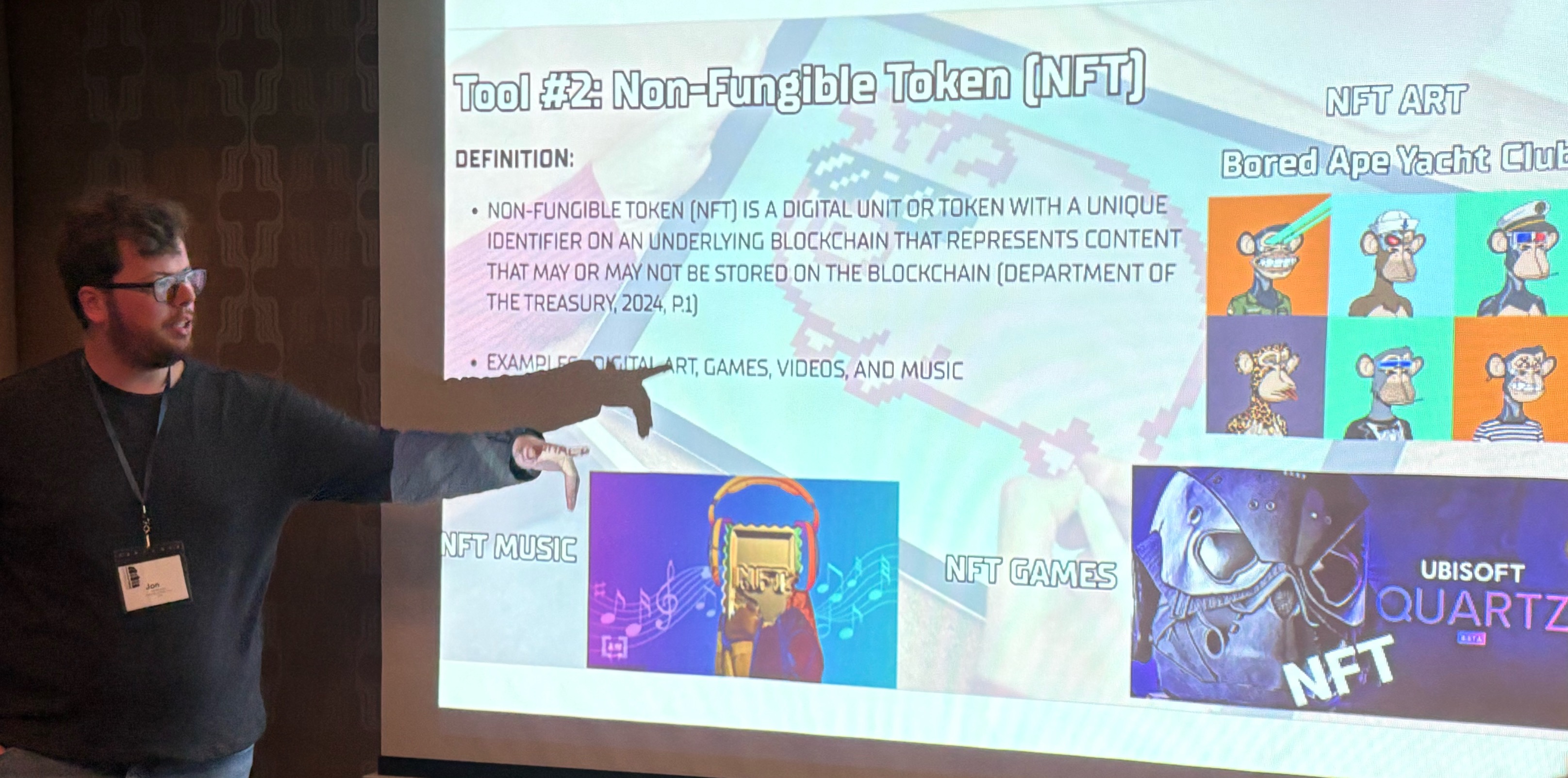
Jon Browning (UG) and Helen Potts successfully presented their presentation Cybercrimes: Cryptocurrency, NFTs, & Generative AI on March 18th at the International Organization of Social Sciences and Behavioral Research Conference in New Orleans, LA.
Jon Browning's project won the "Best Paper" award at this conference.
McKensi Bryce


Pictured above: undergraduate Sociology major, McKensi Bryce, presenting her work for UNT Scholar's Day (04/04/2023).
Bryce's presentation for UNT Scholar's Day, titled "What is your sex? Reaction to Conventional Sex/Gender Questions among Non-Binary Respondents," was based on her analysis of interviews with non-binary individuals in the Midwest, West, and South regions of the United States. This project sought to examine how nonbinary individuals responded to questions about sex and gender in a binary fashion. Interviewers gathered 123 participants from the aformentioned regions. Most respondents hesitated or indicated confusion to these questions, noting that a more inclusive set of questions would provide a more accurate result in many surveys.
Jackson Byrum
Jackson did a Special Problems course with Dr. Potts applying sociological theory
and research to current politics while he was interning at the Capitol in Washington,
DC. He worked for U.S. Senator John Cornyn, one of two Senators who represent the
state of Texas. Examining the Senate from his perspective revealed some sociological
themes and dynamics at play in Washington D.C. and nationally. The main sociological
themes he observed firsthand were the power dynamics of our political system, racial
inequalities inside and outside Congress, and the pivotal factor of class division.
Terrell Dawkins
Terrell worked with Dr. Potts to research the intersection of work and sports. He
put a particular focus on career paths and employment after graduation in the sports
industry. Terrell Dawkins is a UNT Football player.
Alexis Hazlett

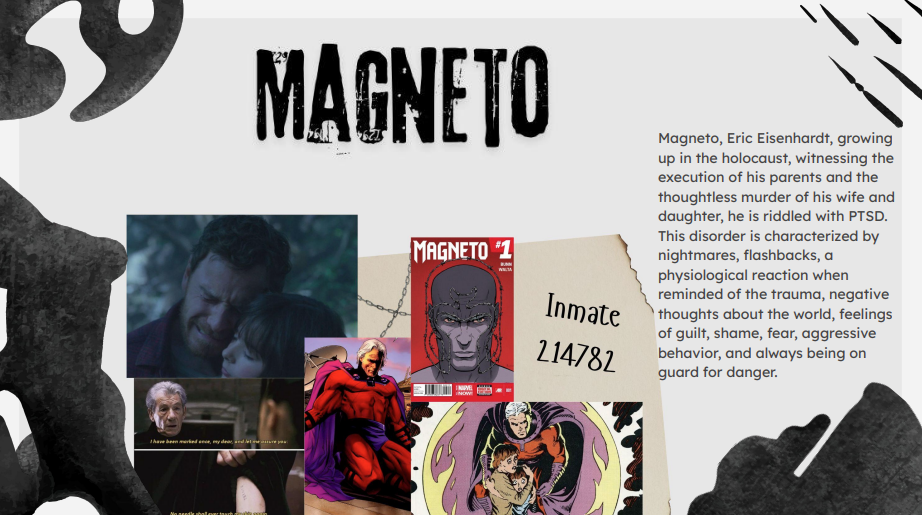
Alexis researched and explored the minds of superheroes and villains. This research reviewed information from comics, movies, and tv shows to illustrate the common threads tying mental health issues and similarities between villains and superheroes. Though heroes and villains are portrayed as polar opposites, both are demonstrated to struggle with mental health issues, which can be a result of their social interactions, social standings, relationships, etc. The representation of mental health in these characters, while sometimes flawed, draws attention to the multiple disorders that everyday people face and can even encourage people to talk to someone, seek help, or gather more information.
River McFarlane
River researched the role of trust and social capital on forming attachments in varying cultures. From a psychological understanding to a sociological one, thier paper attempts to outline the main frameworks used to understand the impact of the economy and culture on the quality of one’s relationships and the dynamics of such relationships.
Marley Nelson
Marley researched the mental health resources in the United States penal system. This research will focus on the tie between mental health resources and their impact on recidivism rates.
Xavier Richmond
Xavier Richmond researched the social perceptions and treatments of schizophrenia.
They found that Schizophrenia is a disorder that affects the way people think, feel,
and act/behave. The disorder is usually caught and diagnosed around 16 to 30 years
old with males being seen earlier than females. The disorder is persistent and can
affect daily life as it targets and changes things like cognition, social relationships,
motor impairment, and expression of emotions. Overall schizophrenia is a major mental
illness disorder that affects
every aspect of an individual's life.
Recent News
-
Garnard, Ileana (December 11, 2025). "UNT sociology professor heads unique cybercrime initiative." The Learning Ecosystem for Empowering Futures (LEEF). University of North Texas.