 University of North Texas

- Current Students
- Discover CLASS
- Scholarships
- Back
- Scholarships
-
- Apply for Scholarships Online
- Dean's List Scholarship
- Dean's Graduate Scholarship
- The UNT Endowed Fund for College of Liberal Arts & Social Sciences Scholarship
- Charles T. & Mildred L. Newell Memorial Scholarship
- The Fenton Wayne Robnett Endowed Scholarship in Social Sciences Teaching Certification
- The Voertman-Ardoin Memorial Scholarship
- The Voertman-Ardoin Scholarships in Liberal Arts
- The A. M. Willis Endowed Scholarship
- The Eagles with Mettle Scholarship
- Other Types of Financial Support
- People
- Resources
- About Us
- CLASS Events
- Give
CLASS Organization Chart & FAQs
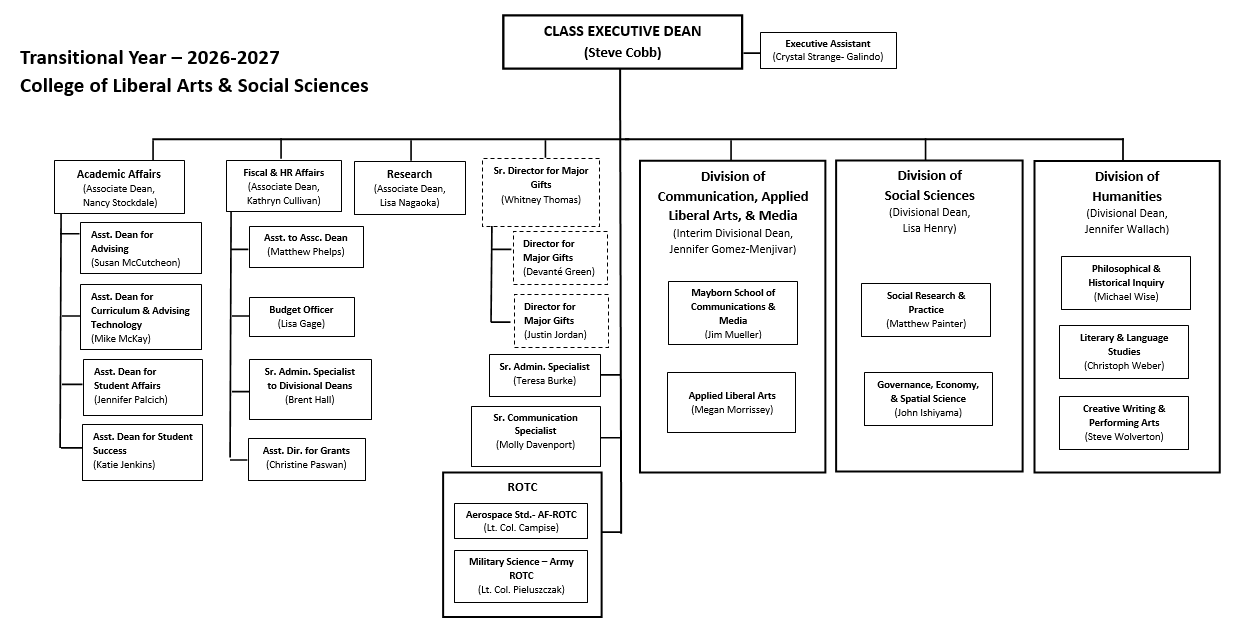
CLASS Organization Chart
UNDER CONSTRUCTION
We are currently transitioning to a school-based model to better serve our community. Thank you to our students, faculty, staff, alumni, and friends for your partnership and patience as we build our future together.

General FAQs
Q: When is the target launch for the finalized reorganization of CLASS and will there
be any consideration for program adjustments and/or changes to be made to the proposed
structure ?
A: The start of the Fall 2027 semester is when the finalized reorganization will be fully implemented. New school directors have been appointed and will begin in these leadership roles in the transitional year, beginning Fall 2026. While restructuring conversations have begun and are currently underway, we will have opportunities to adjust the proposed structure, as needed.
Q: Will departments still exist after this restructuring of CLASS?
A: No. Under the new structure, departments will be organized into mission-themed schools to enhance interdisciplinary collaboration and administrative efficiency.
Q: Will scholarships, advising, and awards be impacted by the restructuring?
A: No. All faculty and student awards, scholarships, and advising services will carry
over seamlessly into the new school structure. We are working closely with the planning
committee and university advancement to ensure that all records and restricted funds
are correctly aligned with their new administrative homes. Additionally, the planning
committee is collaborating with university IT leadership to better integrate CLASS
into the Eagle Scholarship portal, promoting greater efficiency and transparency in
the scholarship and awards processes for faculty, staff, and students.
Q: What will CLASS new academic administrative structures be called?
A: Divisions and Schools.
Q: What is the goal of this reorganization and is a reorganization the best way to
accomplish this?
A: The goal of this transition is to create a more sustainable and collaborative organizational foundation for the college. While the short-term focus involves identifying budgetary savings through streamlined operations, the enduring objective is to remove the silos that often hinder interdisciplinary work. This school-based model provides a framework for faculty to better connect with one another's research and teaching, leading to more consistent policies and a culture that actively invites engagement. Ultimately, the goal is to ensure that administrative operations directly support scholarly and student success, providing a foundation for the college to drive UNT’s future growth and innovation.
Q: When is the target launch for a finalized restructuring of CLASS?
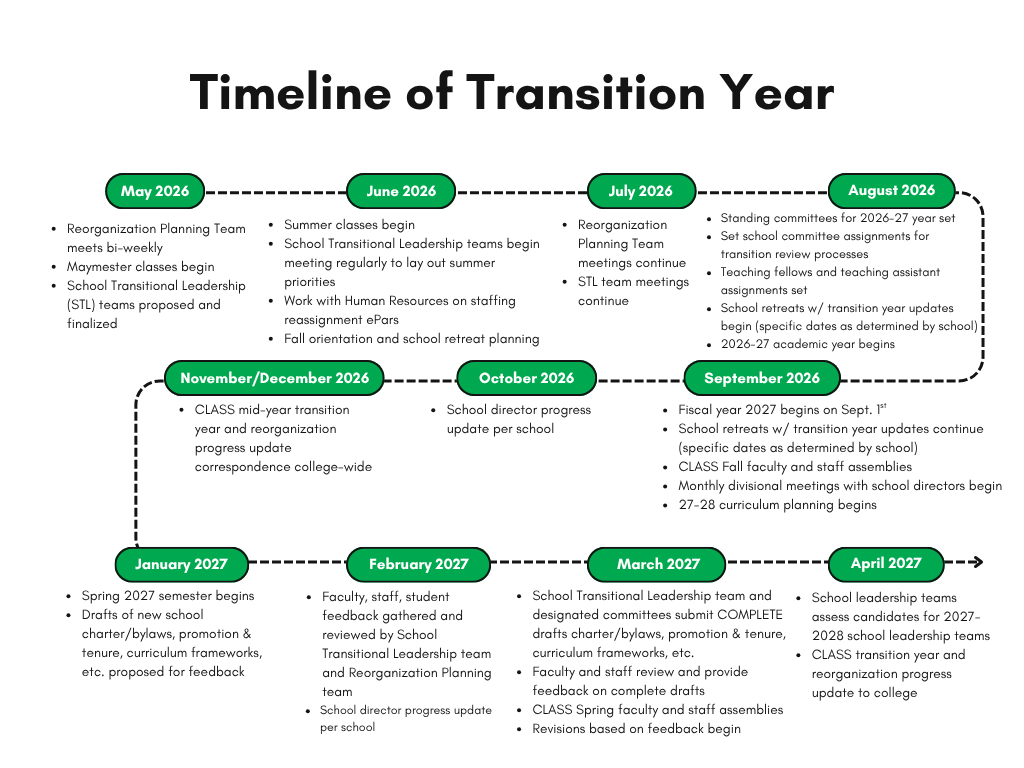
A: The start of Fall 2027 semester. The timeline above shows the anticipated steps toward completion of the college’s new structure.
Q: How will the CLASS website be managed to reflect restructuring changes?
A: To support the college's restructuring, CLASS is updating its website navigation and landing pages to prioritize new divisional units. Led by the Sr. Communications Specialist and the planning committee, all structural updates are coordinated through the Dean’s Office and University Communications. We are auditing faculty and staff listings for accuracy and implementing archival protocols to ensure historical data remains accessible as the primary interface transitions to the new model.
Q: Will restricting into a school-based model impact grant seeking and UNT’s R1 status?
A: Restructuring into a school-based model is being designed to strengthen, rather than hinder, our research enterprise. The move toward more cohesive divisional units is intended to foster greater interdisciplinary collaboration and provide more robust, specialized administrative support for faculty. By streamlining these processes, the college aims to create a more competitive environment for grant seeking, ensuring that our infrastructure scales effectively with the university’s research ambitions and all current and future Carnegie R1 commitments.
Q: Are the concerns of the CLASS community being heard?
A: The concerns of the CLASS community are being heard and are central to the ongoing planning process. We recognize and validate the serious concerns raised by faculty and staff, particularly regarding the potential loss of program identity, diminished academic reputation, and the possible erasure of existing interdisciplinary efforts. These issues, along with concerns about negative impacts on administrative and curricular coordination, require collective and thoughtful solutions. By addressing these challenges directly, we aim to ensure the transition is informed by the diverse perspectives and expertise of our faculty and staff.
Q: How is CLASS staff represented in the planning of the restructure?
A: Three staff representatives serve on the planning committee to provide input and perspective related to staff needs, roles and responsibilities across the college.
Q: What feedback has been received regarding the restructure?
A: There is support within the college for the potential benefits of a more integrated model, specifically:
-
- Improve cross-team collaborations: Bridging units to enhance our capabilities to better tap into collective expertise and diverse resources while reducing redundancies more effectively.
- Enhanced Coordination: Identifying newfound efficiencies in administrative and logistical workflows.
- Modern Pedagogy: Aligning our curriculum with the needs of a modern workforce while maintaining our commitment to the human condition.
- Ongoing Dialogue: We respect there are concerns and that some are reserving final conclusions as they engage in the learning process with us.
Q: As faculty member, I will be housed in the “School of __________”. Will I be able
to call myself an associate professor of Political Science, a professor of English,
or an assistant professor of Spanish?
A: Yes, and your administrative affiliation will be in the school.
Q: How do I contribute to the ongoing dialogue regarding our new college structure?
A: Constructive feedback is essential to the success of this transition for our college and the university. Whether you have specific concerns or see new opportunities for synergy, we want to hear from you:
-
- Ongoing listening and update sessions: Participate in unit-level meetings hosted by the school and/or divisional leadership throughout summer months and as well as the following 2026-27 academic year.
- Direct outreach: Reach out to your school director/divisional dean to request a designated time to chat more.
Q: How will we assess the impact of this reorganization?
A: Throughout the transition year and beyond, leadership will utilize ongoing feedback from the CLASS Faculty Council and other shared governance bodies to determine how effectively the school-based model supports the strategic priorities and long-term sustainability of the college. Impact will be assessed through a multi-dimensional and multi-factor evaluation of the college's operational efficiency, financial stability, and academic impact during and after the transition. The college will monitor key performance indicators such as the effectiveness of the new divisional model, the streamlining of administrative workflows, and our ability to strengthen resources within the broader university fiscal environment. Additionally, a significant measure of impact will be the consideration of the student experience and the degree to which the new structure fosters interdisciplinary research/scholarship/creative activity and collaboration.
Leadership and Shared Governance
Q: Will there be a need to create an additional tier of leadership reporting to school
directors to support the operations of each school?
A: Schools may decide to introduce roles such as program coordinators or associate directors to help manage program‑level operations, especially during the transition to the new structure. These positions could be temporary for the first year as schools adjust, or they may become permanent if ongoing needs justify them. Each school will have the flexibility to shape its own leadership model, so the specific roles and structures may vary based on the unique demands, size, and complexity of the programs within that school.
Q: Will each program in a school continue to have a Graduate Program director? Will
each program in a school continue to have a Graduate Program director?
A: Each school will continue to have a Graduate Program Director. The number of individuals to serve in such a role will be determined over the transitional year and the specific scope of their responsibilities and administrative alignment will be determined in consultation with the new school leadership to ensure that these roles are effectively supported within the respective divisional framework.
Q: Who leads curricular design?
A: The faculty. Faculty will continue to lead the creation and approval of curricula. This responsibility is unaffected by structural shifts.
Q: Will the college have to create new Personnel Affairs Committees at the college-level,
division-level, and school-level?
A: The college will continue to maintain Personnel Affairs Committees at both the college and school levels within each division. At this time, it is unlikely that an additional division-level committee will be necessary. However, the upcoming transitional year provides a purposeful window for this conversation to unfold, allowing faculty and leadership to evaluate the process in practice and determine the most effective final landing spot for personnel review.
Q: Where will First-year writing and the Writing Center be administratively housed
in this restructure?
A: First-year Writing and the Writing Center will remain essential components of the college’s academic mission. A new governing committee will be formed early in the transition year to oversee these areas, reporting directly to the college or a division and not any one particular school. The goal of this new structure is to broaden the scope of input and collaboration, ensuring we better serve the writing needs of students across CLASS, as well as those from other parts of campus who rely on these courses and the Writing Center for academic support. This administrative alignment is designed to enhance the visibility and impact of writing resources across the entire university community.
Q: Will staff be reassigned to a new supervisor?
A: For some, yes, they will be reassigned to a new supervisor during this transition year, beginning this summer and no later than September. Such reassignments primarily apply to staff whose current supervisor is no longer in a unit leadership role under the new structure. These reassignments for the transitional year will be handled with clear communication to ensure a smooth administrative shift for all affected personnel.
Q: What is the role of the faculty for any proposed changes to CLASS bylaws?
A: Faculty will continue to play a central role in proposed changes to the CLASS bylaws through established shared governance protocols. In accordance with current procedures, any updates to the bylaws will be brought to the faculty by CLASS Faculty Council for consideration and feedback.
Operational Policies, Budget, and Procedures
Q: Will unit policies (e.g. tenure & promotion) be the same for the whole school with
consolidated units? Who will be making these decisions?
A: The schools will be determining all changes necessary of their new unit specific policies in the transitional year.
Q: How will program-specific funds as well as differential tuition be managed under
the new school-based model?
A: The management of unit-specific funds will be reviewed to ensure alignment with the new school consolidations within divisional budget models. While the transition aims to maintain a coordinated oversight of these resources, final protocols for fund management and reporting will be established as the school-based budgetary frameworks are finalized.
Q: Will the new schools have a dedicated budget to host existing events such as award
recognitions, student/faculty research and creative work showcased, and end-of-year
banquets?
A: Each school will have a consolidated operational budget, providing the leadership with the autonomy to make decisions regarding the funding and hosting of school-specific events. This includes continuing to support traditional activities such as award recognitions, student and faculty research showcases, and end-of-year banquets within the school’s new budgetary framework.
Q: How will future faculty lines be determined?
A: Future faculty lines will continue to be determined based on the current strategic needs and priorities of the college as they exist at the time of the request. This approach allows leadership to remain responsive to shifts in enrollment, research opportunities, and instructional demands across the new school-based structure.
Q: Where will faculty tenure be located?
A: Faculty will be tenured in their home school.
Q: Will CLASS be changing the teaching load for faculty?
A: Faculty teaching loads will continue to be determined based on the current instructional needs and strategic priorities of the college. There are no changes to the existing workload policies as a direct result of the restructuring.
Q: As departments are consolidated into schools, will CLASS address salary compression
issues as part of the restructure?
A: Salary compression is a serious, ongoing issue that we are actively working to address. CLASS is working to align its budgetary resources to best support the university merit pool and strengthen its financial position within the new university budget model. While the administrative restructure is focused on organizational efficiency, the college will continue to evaluate salary compensation adjustments, including compression issues, based on available college resources and the broader fiscal environment at UNT. This ongoing evaluation remains a priority as we aim to balance institutional needs with a commitment to competitive compensation.
Facility Management
Q: Where will the administrative office space for each school be located?
A: Administrative office locations for each school will be determined following a comprehensive assessment of our current footprint, conducted in close consultation with the university facilities management team. A primary factor in these considerations is the student experience, ensuring that offices are located and staffed to provide optimal access and support for the students we serve. This collaborative approach aims to balance efficient space utilization with the need for highly visible and accessible administrative hubs within each school.
Q: Where will schools physically be located? Will we be moved around? (Will each school
have a designated physical location?)
A: Given the limited availability of space and the impact of ongoing renovation projects, physical locations for each school are currently being evaluated. It is possible that some units or individuals may be reassigned to new spaces to better align with the school-based structure and improve operational efficiency. Further determinations will be made as the transition year unfolds, and we will provide updates as specific plans are finalized in coordination with university facilities.
Q: Will the staffing of schools be organized to ensure office spaces are staffed during
open business hours?
A: Yes.
Advising
Q: How will existing help centers change/stay the same/be funded?
A: Departments that have help centers will need to internally sort this out within their new school configurations. There is no impact from the college restructuring to services provided by CLASS, such as Take Flight. Additionally, the Career Center will still provide Career Coaches for all CLASS majors, barring any unforeseen change in Student Affairs.
Q: Will students be reassigned to new academic advisors?
A: There is no impact from the college restructuring to services provided by CLASS including Academic Advising and Take Flight. We do not foresee a change in the current structure of faculty advising at this time. CLASS Advising's recommendation is that faculty advisors stay with the majors that they currently serve. That allows the depth of knowledge and expertise to remain with the degrees, which benefits students.
Q: Will the degree on a student’s diploma change due to restructuring?
A: No, because neither departments nor colleges appear on diplomas; the degree and
the university are what appear on diplomas. For example, if someone gets a BA in English
or an MFA in Media Arts, that will be on the diploma, not the unit in which those
degrees are administratively housed. Curriculum changes each year, so over time, changes
will be reflected on students' diplomas.
Advancement
Q: Will there be a need to revise existing and/or future scholarship gifts?
A: Advancement is in the process of reviewing all impacted scholarships now and will reach out to donors to advise if modifications are necessary.
Q: Will we continue to have program-based scholarships?
A: Yes, the scholarship documentation will indicate the specific degree/program and the college.
Q: Will there be a new system to apply for and manage scholarship applications?
A: The college is in the process of having those discussions now and will be making
decisions before the next scholarship cycle begins.