University of North Texas

- Current Students
- Discover CLASS
- Scholarships
- Back
- Scholarships
-
- Apply for Scholarships Online
- Dean's List Scholarship
- Dean's Graduate Scholarship
- The UNT Endowed Fund for College of Liberal Arts & Social Sciences Scholarship
- Charles T. & Mildred L. Newell Memorial Scholarship
- The Fenton Wayne Robnett Endowed Scholarship in Social Sciences Teaching Certification
- The Voertman-Ardoin Memorial Scholarship
- The Voertman-Ardoin Scholarships in Liberal Arts
- The A. M. Willis Endowed Scholarship
- The Eagles with Mettle Scholarship
- Other Types of Financial Support
- People
- Resources
- About Us
- CLASS Events
- Give
Research
The LEAPH is more than a multimedia lab and meeting space, it's a place to generate and uplift faculty and student research projects that have public-facing components.
This lab brings together students and faculty from diverse interdisciplinary backgrounds,
providing valuable experiences for students while also engaging with the public to
demonstrate how academia can connect with surrounding communities. This commitment to supporting diverse topics is evident in the various current projects,
from plants and animals to the neuro-diverse experience. While each project is uniquely
different, there is an overarching theme of understanding how the human experience
interacts and shapes the surrounding world.
Explore the current projects being supported by LEAPH below.
Milpa Agricultural Placemaking Project
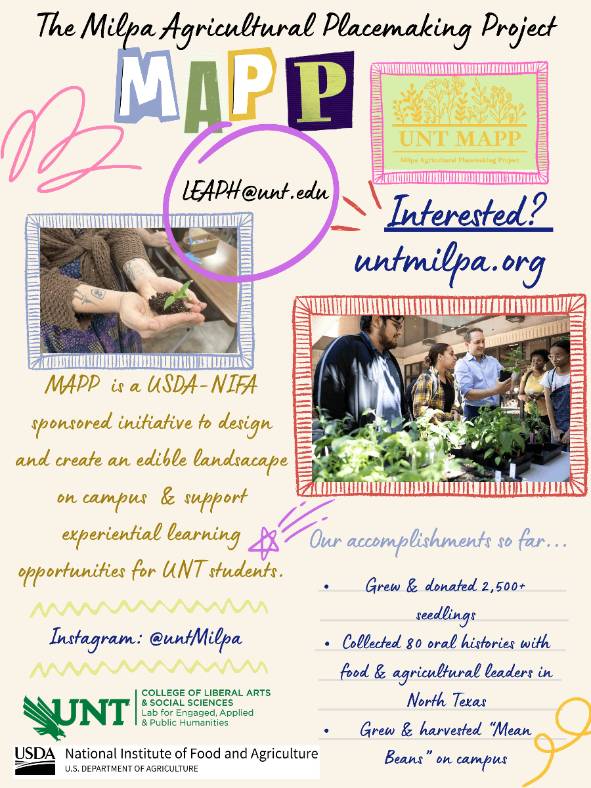
The Milpa Agricultural Placemaking Project (MAPP) at the University of North Texas is an innovative initiative in transforming the way food is grown, studied, and shared on the UNT campus. Supported by a $400,000 grant from the USDA's National Institute for Food and Agriculture, the MAPP team is focused on bringing the ancient concept of milpa—a sustainable agricultural practice originating in Mesoamerica—to create edible landscapes across UNT.
The MAPP project goes beyond creating edible micro-climates by establishing open diaologue with the surrounding communities that utilize these shared spaces. This is established through the MAPP Oral History Collection, a multilingual database of interviews with community members involved in food and agriculture.
MAPP, is led by Michael Wise, professor and chair of the department of history, and Sandra Mendiola García, oral history director and associate history professor.
To learn more about this initiative, explore their website.
Neuro-Narratives Project
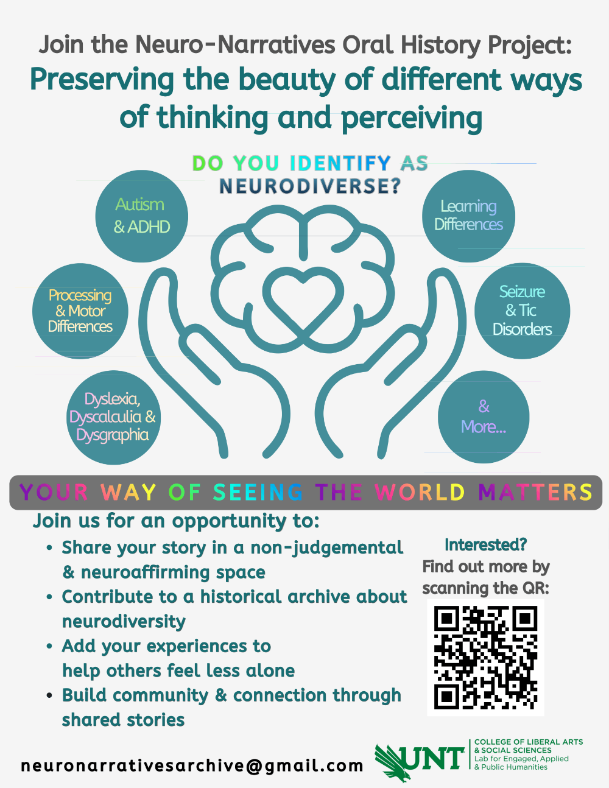
The Neuro-Narratives Project is a true depicition of interdiciplinary partnership. Faculty and students from the Departments of History, English, Design and Rehabilitation and Health Services are all coming together to create a digital museum, which will use multiple forms of storytelling, including creative writing, oral history, and art and design, to document the experiences of neurodiverse people.
This initiative to create a public resource establishes a living representation of Neurodiversity that intimately reflects and lifts up the stories, knowledge and perspectives from autistic and neurodiverse community members.
The Neuro-Narratives team consists of Kimberly Grey, an assistant professor of creative writing; Sara Park, an assistant professor of rehabilitation studies; Jeanine Vail, an assistant professor of interior design; Jennifer Wallach, a professor of history; Amber Brasher, graduate student assistant; Alison Kelly, Administrative Coordinator for the Division of Humanities; and Caeden Cooley, a doctoral student in history.
Texas Animal Humanities Project
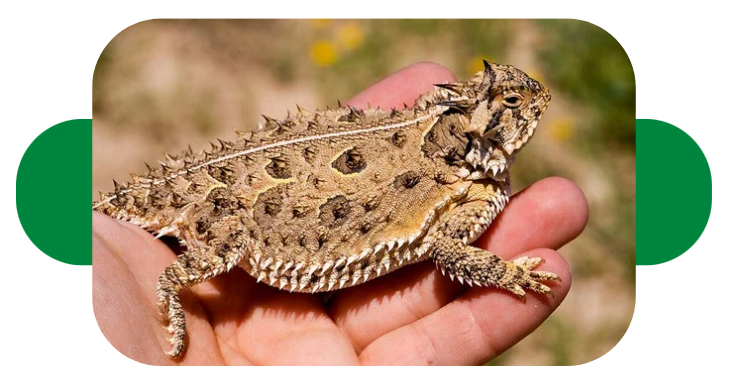
Cecelia Alexander, Phrynosoma cornutum, 22 August 2010, Public Domain, via flickr.
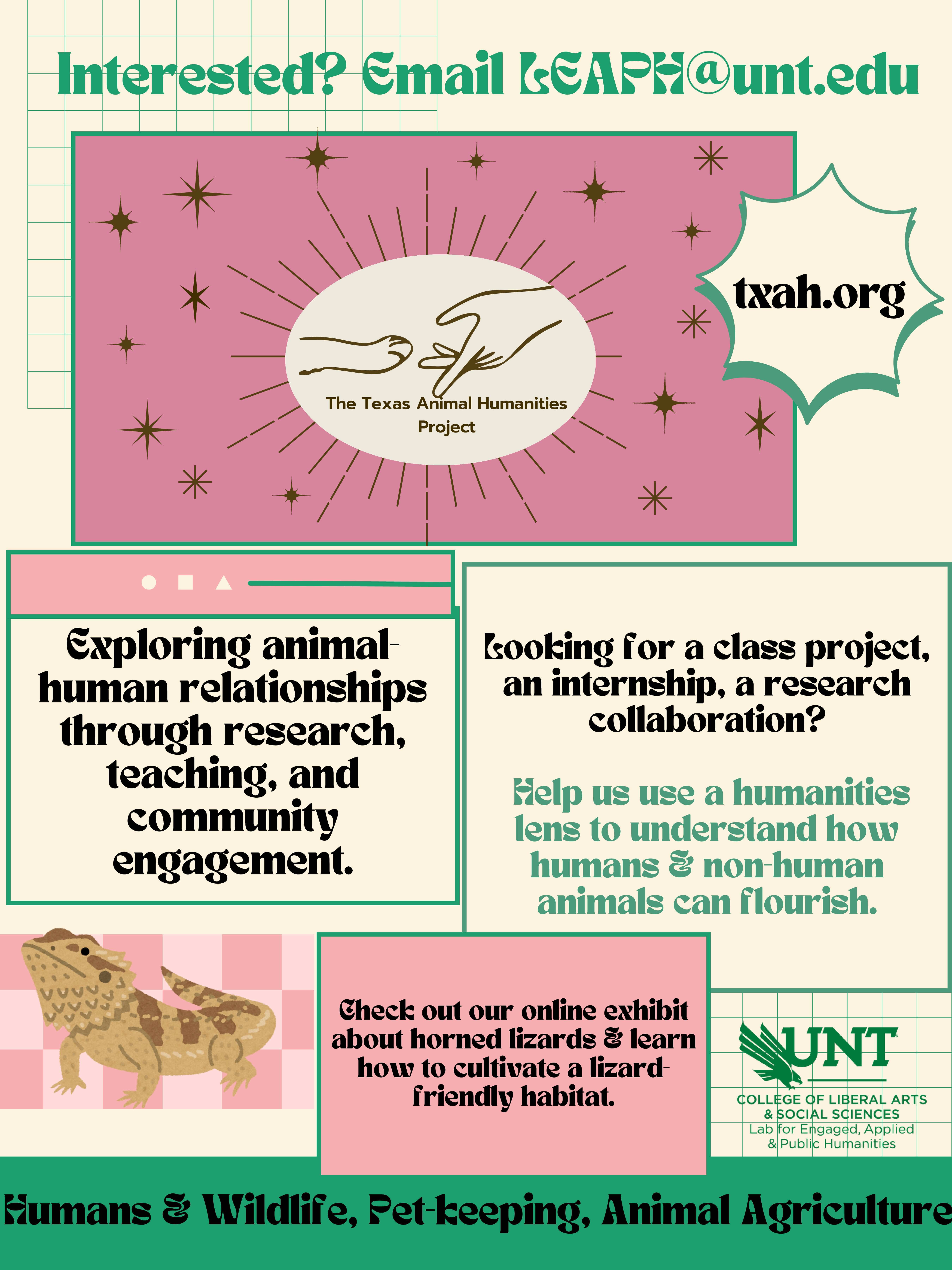
The Texas Animal Humanities Project is a joint collaboration between faculty and researchers from the Departments of History and Philosophy and Religion. Together these two departments helped cultivate and house Dusty Rhoads' research "Historical Horny Toads: A History of the Texas Horned Lizard as Pets."
Their initiative blends humanities scholarship with ecological conservation efforts. In the case of the Horny Toads, students helped prepare native seed blends to cultivate habitats that attract and provide shelter for threatened Texas horned lizards. The TXAH also promotes other animal humanities projects by exploring animal-human relationships through research, teaching, and community engagement.
The TXAH team consists of Jennifer Jensen-Wallach, professor of history and Divisional Dean of UNT Humanities; Leah Kalmanson, Baghwan Adinath, professor of Jain Studies; Michael Wise, professor and chair of the department of history; and doctoral students Ani Steele, Basmah Arshad, Madison Black, and Marisa Moreno.
The Texas Animal Humanities project is supported by the Summerlee Foundation.